In the first installment of Inside Project Renaissance, I explained how a series of technical problems forced me to stop patching The Haus Of Legends one issue at a time and ask a much larger question: was the website still worth saving, or had it finally reached the point where tearing everything down and starting over made more sense?
The answer became Project Renaissance. Instead of demolishing years of work, we decided to renovate. We created a Master Blueprint, divided the project into phases, established rules for what we would and would not do, and committed ourselves to understanding each system before changing it.
Then we immediately did something slightly unconventional. We skipped ahead. Rather than beginning with Phase I, we made a deliberate decision to start with Phase III: Catalog Cleanup.
There was a reason. The product catalog had become one of the largest concentrations of accumulated history on the entire website. Years of artwork, merchandise, experiments, collections, suppliers, categories, naming systems, discontinued ideas, and print-on-demand products were all living together inside WooCommerce.
Before we could seriously reorganize the store, improve the customer experience, rebuild the navigation, or begin optimizing hundreds of product pages, we needed to know what we actually had. That sounded simple enough: export the products, review them, remove what no longer belonged, and clean up what remained. Naturally, it was nothing like that.
First, We Had to Understand What We Were Allowed to Touch
The Haus Of Legends uses WooCommerce as its storefront and Printify as a major print-on-demand production partner. To the customer, those systems appear to be one store. Behind the scenes, however, they perform very different jobs.
WooCommerce handles the customer-facing product page, categories, descriptions, checkout, and transaction. Printify handles the production relationship: the actual product, print provider, variants, fulfillment information, and the identifiers that allow an order placed on The Haus Of Legends website to become a physical item.
That connection immediately created the first major rule of Phase III: we could not clean the catalog by treating every WooCommerce product like an ordinary webpage. If we changed the wrong information or recreated products carelessly, we risked disrupting the relationship between the storefront and fulfillment system.
Before making large-scale edits, Nova and I worked through what Printify needed to retain control over and what WooCommerce could safely manage. The production-side identifiers—particularly SKUs, variants, and fulfillment relationships—had to remain intact. The customer-facing presentation, however, belonged to The Haus. Titles, descriptions, categories, artistic identity, SEO, and the way artwork was organized could be improved without allowing the supplier to define the public voice of the business.
That became an important distinction throughout the entire phase: Printify produces the product. It does not define the artwork.
Then We Looked at the Size of the Problem
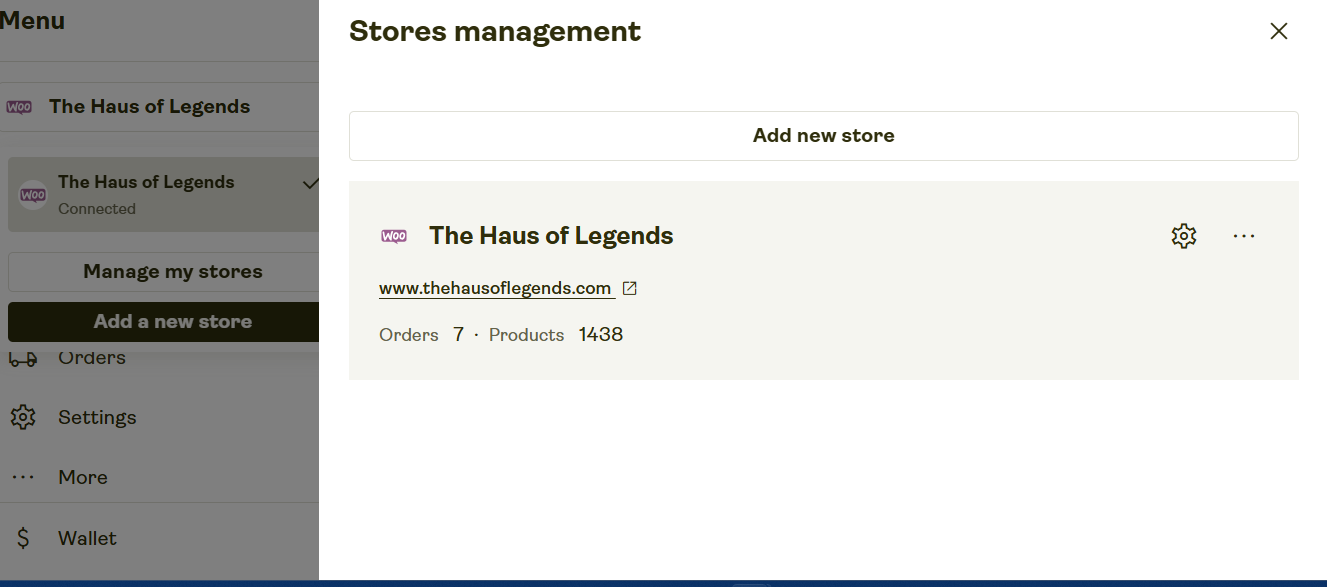
One of the screenshots I took during the process showed the connected Printify store reporting 1,438 products. That number was a sobering visual representation of what we were about to tackle.
As we moved into the WooCommerce data itself and separated parent products from other records, the working baseline for the audit became 1,369 parent products. Twenty-five products had already been identified for deletion on the Printify side, leaving 1,344 active parent products to process through the main catalog audit.
Even establishing that baseline was useful because it demonstrated something we would encounter repeatedly during Project Renaissance: different systems can describe the same business differently. Before you start deleting anything, you need to know what you are actually counting.
Getting the Catalog Out Was the First Battle
To properly analyze the catalog, we needed the WooCommerce product information in a form that could be compared, filtered, audited, and eventually updated. CSV was the obvious solution.
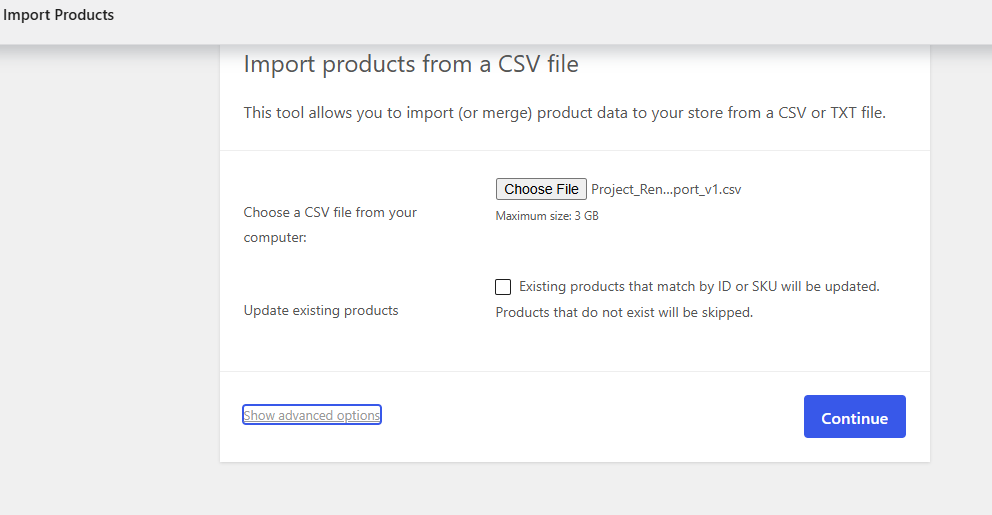
We exported the product data, prepared the updated information, and attempted to bring it back into WooCommerce. That is when the website essentially responded: no.
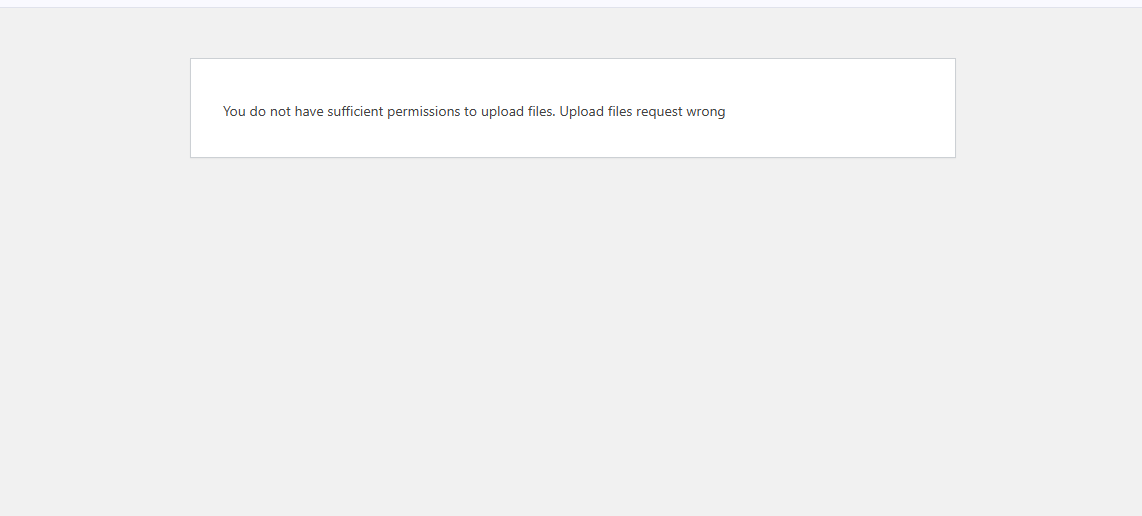
The first upload attempt failed with a permissions error. After tracing the problem, we discovered that CleanTalk’s Upload Checker, one of the security tools protecting the website, was blocking the CSV upload.
This was actually a perfect Project Renaissance problem. The security software was not malfunctioning in the traditional sense. It was trying to protect the website. Unfortunately, the completely legitimate administrative action we were attempting looked suspicious enough to be stopped.
So the solution was not to remove the security system. It was to temporarily disable the specific protection interfering with the controlled import, complete the work, and restore the protection afterward.
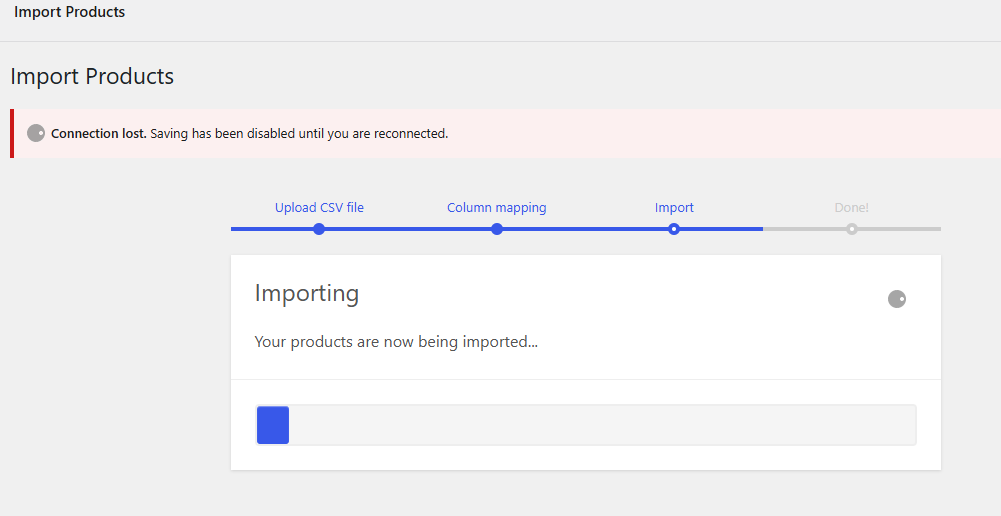
With that problem identified, we tried again. The import began. Then the connection dropped. WooCommerce displayed the wonderfully reassuring message: “Connection lost. Saving has been disabled until you are reconnected.”
There are moments when rebuilding a website feels sophisticated and strategic. This was not one of them.
When 1,344 Products Would Not Cooperate, We Changed the Plan
Our initial idea had been to process the complete set of 1,344 active parent products together. That proved to be too much. The import stalled.
At that point we had two options. We could continue trying to force the large import through, or we could accept that the system had just given us useful information and adjust the process. We adjusted.
The catalog was divided into 14 separate batches: thirteen batches containing 100 products each and a final batch containing 44. One by one, those batches were processed.
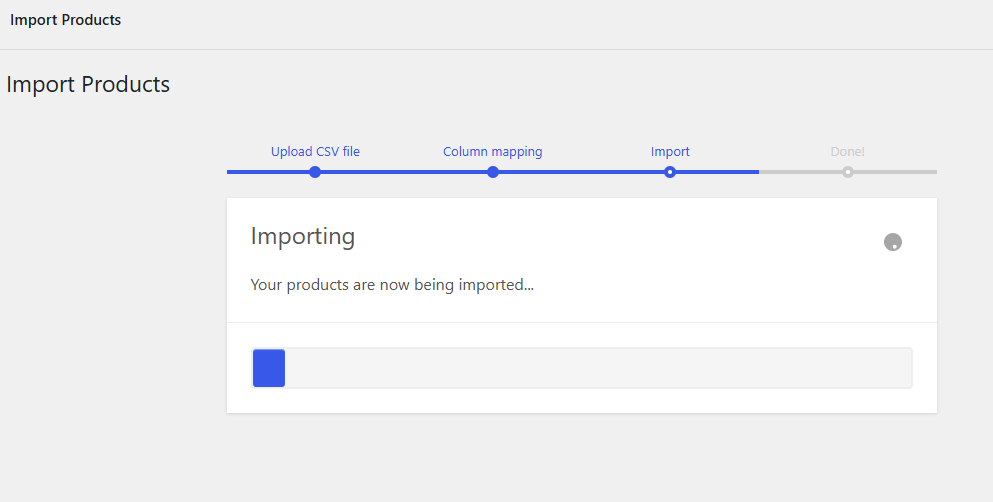
It was slower. It was less elegant. It also worked. This became one of the recurring lessons of Phase III: efficiency does not always mean doing the largest possible operation at once. On a live ecommerce website, a smaller repeatable process that can be verified is often considerably safer than one massive action that fails halfway through.
Once the Data Was Visible, the Real Cleanup Began
Getting the catalog exported and processed was only the beginning. Now we could start examining what several years of organic growth had actually produced.
Some issues were easy to understand immediately. We found duplicate and overlapping category structures. One screenshot, for example, showed two separate Psychedelics categories. One contained 70 products. Another contained 2.
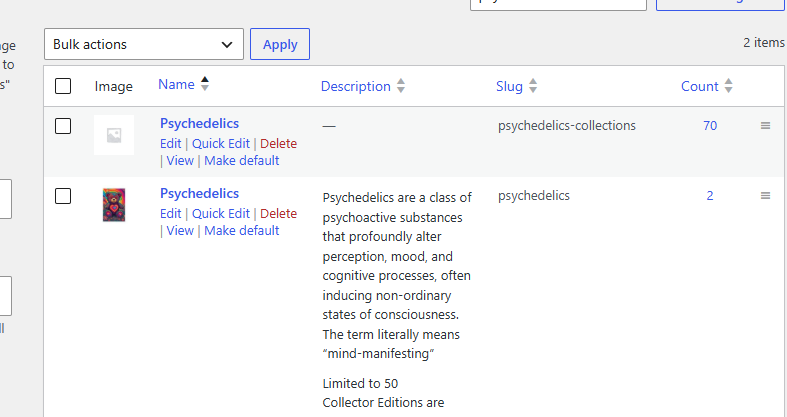
No customer visiting the website would know or care how those duplicate categories were created over time. They would simply experience the resulting inconsistency. That is precisely the kind of problem Project Renaissance was designed to uncover.
Other problems required considerably more judgment. The description audit identified 129 products with duplicated openings and 62 possible product-type mismatches requiring review.
Supplier-generated language appeared beside Haus-written copy. Technical specifications were useful but sometimes overwhelmed the artistic presentation. Some products had customer-facing names that described the manufactured object better than the artwork itself.
This led to another important decision. We were not going to erase useful production information simply because it sounded technical. Paper weight matters. Materials matter. Printing methods matter. Care instructions matter. Size information matters. A collector buying physical artwork deserves accurate specifications.
The solution was not to replace all of that information. It was to separate its function from the artistic description. The artwork should speak first. The manufacturing details should support it.
Then We Found the Notebooks
And we found a lot of them. The initial analysis identified 346 generic spiral notebooks within the active catalog.
The Haus Of Legends had evolved significantly since many of those products were created. Publishing had become more deliberate. The Creative Bridge was no longer simply another notebook-type product; it had become the foundation of an educational journal system with a specific purpose, structure, and identity.
That distinction mattered. The three Creative Bridge journals were specifically protected from the general notebook cleanup. Generic print-on-demand notebooks and purpose-built publications were not the same thing merely because both happened to contain pages you could write on.
After further review, the retirement work ultimately resulted in 359 spiral notebooks being removed from the active catalog.
Removing a Product Does Not Remove Its History
A product can disappear from the store with one click. Its URL does not disappear from the rest of the internet quite so conveniently.
A product may have been indexed by Google. It may appear in an old blog article. Someone may have bookmarked it. It may have been shared on social media. It may exist in search results or external links. Simply deleting hundreds of products and allowing all of those URLs to become dead ends would replace catalog clutter with a different problem: hundreds of 404 errors.
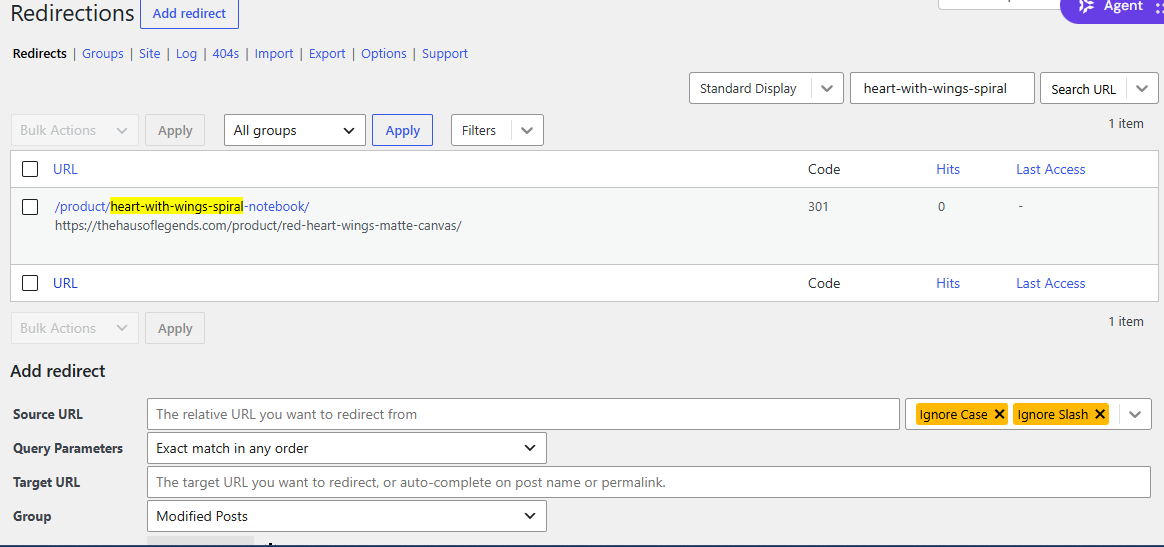
So we created a retirement and redirect strategy. Where an obvious successor existed, an exact redirect could be created. Where a discontinued product belonged logically within a surviving collection, it could lead to the relevant collection page.
But we also established another important rule: we would not create misleading redirects merely to avoid a 404. If there was no responsible destination, we would not pretend that an unrelated product or collection was the same thing.
The final redirect work produced 67 exact product redirects and 103 collection-level redirects, for a total of 170 working 301 redirects. Another 189 retired URLs had no responsible direct match.
And Then the AI Tried to Retire Five Pieces of Art
This may be my favorite part of Phase III because it demonstrates exactly why I believe AI should assist creative decision-making rather than blindly control it.
During one stage of the cleanup, five watercolor posters were caught in the retirement analysis. Nova had identified them as candidates. I stopped the process because there was no good item-level reason those five artworks should be removed. They were not generic notebooks. They were not obsolete supplier experiments. They were artwork.
So we went back and reviewed them. All five stayed.
That incident represents something much larger about how we are approaching Project Renaissance. AI can analyze patterns extremely quickly. It can identify duplicates, compare descriptions, flag anomalies, and help organize enormous amounts of information that would otherwise take me days or weeks to process manually. What it cannot do is replace the creative and business judgment of the person responsible for The Haus Of Legends.
The system made a recommendation. I challenged it. We reconsidered the evidence. The decision changed. That is exactly how I want this collaboration to work.
We Were Not Cleaning Numbers. We Were Curating a Business.
Another lesson became increasingly clear as we worked through the catalog: a product with no sales is not automatically a worthless product.
Some pieces exist because they belong to a collection. Some support a larger artistic idea. Some may have educational relevance. Some may be new enough that sales history tells us very little. Some simply need better presentation before anyone can reasonably judge their potential.
The purpose of the Phase III audit was therefore not to create an algorithm that said: No sales = delete. That would have been easy. It also would have been foolish.
From 1,369 to 1,000
By the end of the main Phase III cleanup, the active catalog had been reduced to 1,000 products. That number is satisfying, but the number itself is not the accomplishment.
We did not simply select 369 products and press Delete. We identified platform dependencies before touching the catalog. We protected fulfillment connections. We exported and analyzed the WooCommerce data. We discovered that our first import method was being blocked by security software. We worked around connection failures. We abandoned an oversized import and processed the catalog in 14 controlled batches.
We found duplicated categories, duplicated description openings, possible product mismatches, generic merchandise that no longer fit the direction of the business, and years of supplier information mixed into customer-facing content. We protected The Creative Bridge from being mistaken for ordinary notebooks, retired 359 spiral notebooks, created 170 responsible redirects, and refused to invent redirects where no logical destination existed.
And when five pieces of artwork were incorrectly caught in the cleanup, we stopped and saved them.
That is what the number 1,000 represents. Not reduction for the sake of reduction. Curation.
What Phase III Changed
Before Project Renaissance, the catalog largely reflected the history of everything that had been added to The Haus Of Legends. After Phase III, it began reflecting something different: intention.
That does not mean every surviving product page is now perfect. There is still rewriting to do. Artwork-family structures still need development. Collection pages need improvement. Product photography and visualization can be strengthened. Limited-edition information needs standardization. The art-commerce experience still has an entire phase of its own.
But we now know what we are building on. That is a very different place from where we started.
Why We Started With Phase III
Looking back, skipping ahead to Phase III was the right decision. The Project Renaissance Blueprint was intentionally designed as a sequence, but a blueprint is also a planning tool, not a prison.
The catalog represented too much structural weight to leave untouched while we began making other decisions around it. There was little point building beautiful collection architecture around products that might ultimately be retired. There was little point rewriting hundreds of descriptions before deciding which products belonged in the permanent catalog. There was little point trying to reorganize customer navigation while we were still unclear about the inventory underneath it.
We needed to clear the room before deciding where all the furniture belonged.
Now that we have done that, something interesting happens. We go backward. The next chapter of Project Renaissance returns to the beginning of the Blueprint: Phase I — Cleanup & Trust Foundation.
Because apparently The Haus cannot renovate anything without discovering at least three additional rooms behind the wall.
Project Renaissance continues.