At the end of Phase III, we had reduced a catalog of 1,369 parent products to 1,000 active products, retired hundreds of items that no longer belonged, protected the connection between WooCommerce and Printify, and created 170 redirects to preserve as much of the old catalog history as responsibly possible.
We had cleared the room. Now, as promised, we were going backward.
The next stop in Project Renaissance was Phase I: Cleanup & Trust Foundation. Compared with sorting through more than a thousand WooCommerce products, Phase I looked almost modest on paper: review the legal pages, verify the business information, correct naming and spelling problems, test important URLs, and review subscriber messaging, returns, licensing, copyright language, and customer-facing trust information.
It looked like housekeeping.
Anyone who has ever renovated a house, restored an old car, or tried to repair something that has been working “well enough” for years already knows what happened next. You pull off a piece of drywall because of a stain and discover an old pipe behind it. You replace the pipe and find damaged framing. You repair the framing and realize the wiring running through it was installed sometime during the Nixon administration. What began as a simple afternoon repair becomes a weekend project involving three trips to the hardware store and at least one moment when you seriously consider setting the whole thing on fire.
Websites are not that different.
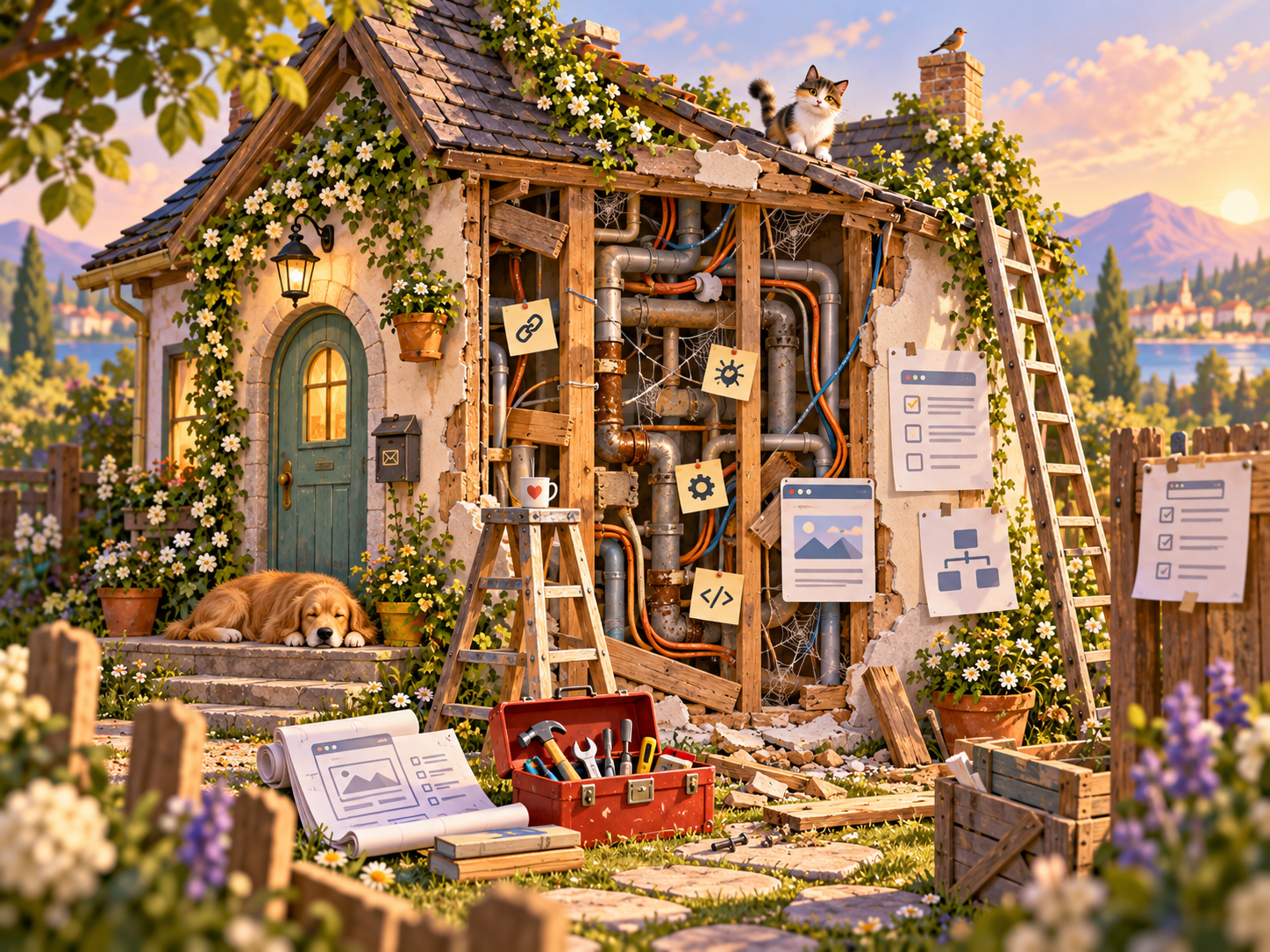
Nearly every Phase I task exposed something connected to something else, and every apparently small correction forced us to ask the same question: If we change this, what else does it affect?
The Pages Nobody Notices Until They Need Them
We began with the trust foundation of the website: the policies and customer information that most people will never read unless something goes wrong. That is exactly why they matter.
The Haus Of Legends had changed significantly over the years. What began primarily as an art and merchandise site had expanded into publishing, educational resources, digital downloads, journals, original intellectual property, limited editions, subscriber benefits, and a much larger body of creative work. The legal and customer-policy pages had not always evolved at the same pace.
Some language had originated from generic templates. Some sections reflected an earlier version of the business. Other parts technically covered what needed to be covered but did so in the kind of language that makes your eyes glaze over halfway through the second paragraph.
I did not want the legal pages on The Haus Of Legends to read like a smoke screen.
There is a particular kind of legal writing that seems designed to make a business look protected precisely because the average person cannot understand what it says: long sentences, dense terminology, layers of qualifications, and paragraphs that sound important while somehow making the reader less certain about what their actual rights are.
That was not what I wanted.
These pages still needed to protect the business and explain responsibilities, intellectual-property rights, returns, licensing, privacy, and other necessary policies. But protection and confusion are not the same thing.
One of my standards became very simple: could my mother read this and understand what we were telling her? If the answer was no, the language probably needed more work.
That changed the entire approach. We were not simply correcting contact information or making sure business details matched from one policy to another. We were reconsidering the message itself.
What is The Haus promising the customer? What happens if something arrives damaged? What can someone do with a digital download after purchasing it? What information do we collect, and why? What belongs to the buyer, and what intellectual property remains with The Haus Of Legends?
Those answers should not require a law degree to find.
During Phase I, we reviewed and strengthened the Terms of Use, Privacy Policy, Refund & Returns Policy, Digital Download Licensing Terms, and Copyright & DMCA Policy. The goal was to retain necessary protections while making the language more direct, honest, and transparent.
The Refund & Returns Policy should not make someone hunt through disclaimers to figure out what happens when there is a problem with an order. The Digital Download Licensing Terms should clearly distinguish purchasing a digital product from purchasing ownership of the intellectual property behind it. The Privacy Policy should explain what information is collected and how it is used without burying the answer inside corporate legalese.
The Copyright & DMCA Policy serves the same larger purpose. The Haus now contains years of original artwork, writing, educational resources, journals, publications, creative systems, and developing intellectual property such as The Creative Bridge. Protecting that work matters, but the process should still be understandable to the people expected to follow it.
This became as much a philosophical decision as a website decision. Trust is not created by saying, “We told you somewhere in the fine print.” It comes from making a genuine effort to tell people clearly what they need to know.
Qualified legal review remains appropriate as these policies continue developing. But even after that review, I still want the final documents to sound like they were written for human beings.
Then One Typo Became a Migration Project
Next came what appeared to be one of the easiest tasks in the entire Blueprint: correct the spelling of Afrofuturisim to Afrofuturism.
One extra letter.
This is where I should probably mention that I am, of course, an award-winning Spelling Bee Champion.
So naturally, the typo had managed to become embedded deeply enough in the website to require a migration strategy.
The misspelling had existed long enough to appear in content, product information, tags, URLs, older records, and WordPress revisions. Correcting the visible spelling was easy. Correcting the URLs was not.
An old URL does not stop mattering simply because you discover it is spelled incorrectly. Google may have indexed it. Someone may have bookmarked it. A blog article may link to it. A social post may still be circulating. Changing the address without accounting for the old one could turn a spelling correction into a collection of broken links.
So one typo became a miniature migration project.
We corrected the active terminology and created 22 redirects covering affected collection, product, and tag URLs. Then we checked the destinations themselves to make sure the redirects actually led to published products, the corrected content, and the proper Afrofuturism tag.
During the final database search, two additional non-public remnants appeared: one inside a draft article and another inside a media-library record. We corrected those too.
The final check found no remaining non-revision WordPress posts, pages, products, drafts, or attachments containing the misspelling.
Historical revisions still contain it, and we intentionally left them alone. They are not public content, and rewriting old database history merely to produce a cosmetically perfect search result would create more risk than value. Sometimes cleanup also means knowing what not to touch.
Rebuilding the Collectors List Meant Testing the Whole Journey
The Collectors List was another task that looked straightforward until we asked the only question that really mattered: does it work from the subscriber’s point of view?
The public offer had become clearer. Subscribers receive early access to selected releases and announcements, updates about artwork, publications and educational resources, and a personal discount code providing 10% off eligible purchases.
But a form appearing on a webpage is not proof that the system behind it works.
So I subscribed myself.
The form accepted the signup and displayed the correct confirmation message. The confirmation email arrived. I confirmed the subscription and was added to the list. Then the welcome email arrived with the promised discount code.
Only then did we consider it verified.
That experience gave Project Renaissance one of its simplest working standards: configured is not the same thing as working. If a customer or visitor has to use it, we need to know what happens when they actually do.
A Customer Found a Problem We Did Not Know We Had
The Reviews page became part of Phase I for a completely different reason.
A recent customer received an artwork with a problem and contacted me about the order. We acknowledged what had happened, collected the information needed, arranged for the issue to be corrected, and kept him informed throughout the process.
The situation was handled well enough that the customer wanted to leave a positive review specifically because of how the problem had been resolved.
That should have been the easy part.
Except he could not find a way to submit one.
That was how I discovered we had another problem.
A Reviews page had existed on The Haus Of Legends before, but somewhere during the website’s history the submission system and public pathway to that page had disappeared. The customer had not encountered a broken form. He had encountered a review system that was effectively invisible.
So we started digging.
Nova located the existing Reviews page and, more importantly, the previous customer testimonials that had already been submitted. The reviews had not been lost. The page had simply become disconnected from the customer experience.
We restored the page, restored the ability to submit new testimonials, verified that the previous reviews displayed correctly on the live website, tested the URL, and then made the Reviews page visible in the navigation.
A Reviews page nobody can find is not doing much to establish trust.
What makes this discovery particularly appropriate for Phase I is that it came from a customer trying to do something positive. He had experienced a problem, felt good about how it was handled, and wanted to tell other people. In trying to leave that compliment, he exposed a weakness in the website that we might otherwise have missed.
The original customer-service problem led us directly to the next repair.
Apparently, even compliments come with renovation notes.
Then the Tools Started Misbehaving
Just as Phase I began looking like it was approaching the finish line, the tools we were using to perform the work decided they wanted a role in the story.
Our WordPress management connection began returning HTTP 429 — Too Many Requests errors, with several requests failing in a tight burst.
The first concern was whether the site itself was under stress. We checked the server environment, including CPU, memory, PHP workers, processes, and the timing of the failed requests. Nothing suggested that the website was collapsing under load.
The evidence pointed more strongly toward temporary rate limiting, but there were several potential layers that might have contributed: server or CDN protection, WordPress security systems, plugin behavior, CleanTalk, Redirection, long-running earlier requests, shared proxy behavior, or overlapping automated calls.
In other words, we had heard a rattle under the hood and now had several possible places to look.

Eventually, the connection recovered without evidence of a larger site failure. Before resuming work, we verified that the connection was healthy, confirmed the site was responding normally, and checked that we had sufficient request capacity to continue.
The interruption was inconvenient, but it reinforced something useful: when a system tells you to stop, sometimes the intelligent response is to stop long enough to understand why.
The Final Closeout
Once the corrections were made, we performed one final verification rather than assuming completion.
The policy pages were checked on the live site. The Reviews system was confirmed publicly accessible. The Collectors List was tested all the way through confirmation and welcome email. The Afrofuturism redirects were checked against real destinations, and the database was searched for remaining active instances of the misspelling.
That last pass is what caught the final two hidden references. After correcting them, we ran the search again.
Zero.
That number was satisfying not because a perfect database search was the objective, but because it represented something different from the way I had often maintained the website in the past. Instead of fixing only the thing directly in front of us, we had followed each issue far enough to understand what was connected to it.
That is the real work Project Renaissance is beginning to teach me.
It Is Never Just the Thing You Came to Fix
Phase III began as a catalog cleanup and eventually touched Printify dependencies, CSV imports, CleanTalk security, stalled uploads, batch processing, duplicate categories, product retirement, and redirects.
Phase I began as trust and cleanup work and led us through plain-language policy writing, subscriber testing, customer reviews, URL migrations, historical database records, and temporary rate limiting.
Neither phase followed a straight line. That is probably the most realistic thing about this entire project.
The visible problem is often only the place where a larger problem finally becomes visible. Websites accumulate history just like houses and old cars do: previous repairs, old systems, abandoned ideas, outdated parts, improvised solutions, and decisions that once made perfect sense but no longer fit what the thing has become.
You do not discover that history by standing across the street admiring the paint. You discover it when you start opening walls.
What Phase I Leaves Behind
Phase I will probably never be the most visually dramatic part of Project Renaissance, but that was never its purpose.
The changes are quieter.
Customers can read policies written to explain rather than obscure. A subscriber can join the Collectors List and receive what was promised. Someone wanting to leave a review can actually find the Reviews page. Old misspelled URLs lead somewhere meaningful instead of becoming dead ends. The website’s public information more accurately reflects the business operating behind it.
Those details may not produce an immediate “before and after” photograph, but they change the relationship between The Haus and the people who interact with it.
That is what a trust foundation is supposed to do.
With that work complete, Phase I — Cleanup & Trust Foundation is officially closed.
Qualified legal review remains an appropriate future layer for the policy language, but the website implementation itself has reached its closeout point.
Next comes Phase II: Information Architecture.
Now that we have cleared the catalog and strengthened the foundation, it is finally time to decide where everything in The Haus actually belongs.
Something tells me that will go exactly according to plan.
Project Renaissance continues.