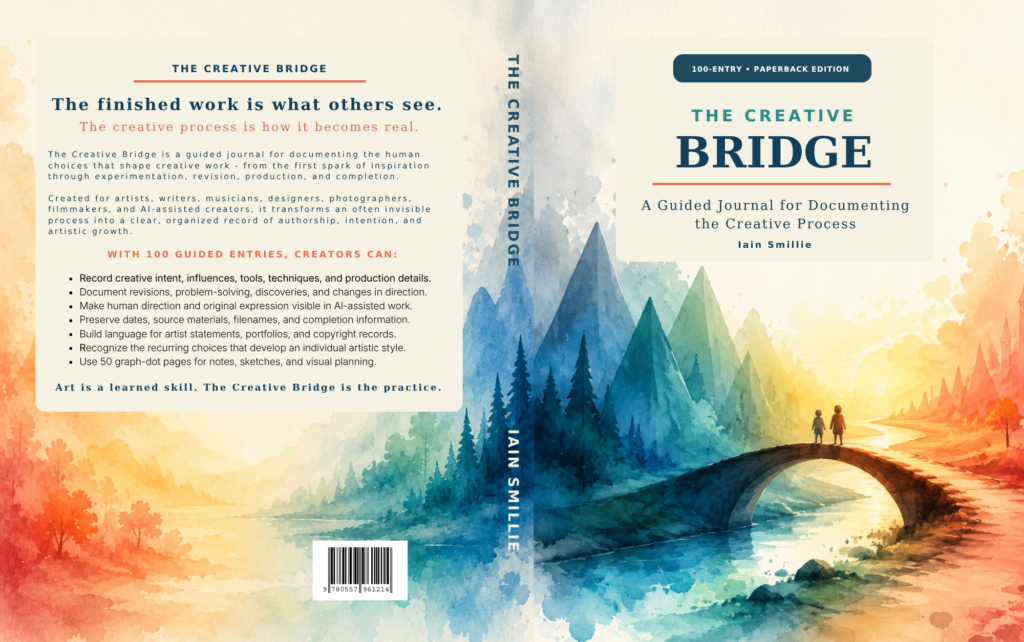
The Creative Bridge A Guided Journal Documenting the Creative Process.
Where Concept Meets Creation
Every creative work begins with a spark of inspiration—an idea that ignites the imagination before it can be seen, heard, read, performed, or experienced. The Creative Bridge.
Inspiration can be fleeting. The longer a creator waits to make the sketch, record the melody, write the sentence, capture the image, or note the idea, the harder it becomes to recover its original clarity and energy. Beginning is the first act of crossing the bridge: the moment imagination starts moving toward reality.
A work may begin as an image, phrase, melody, memory, question, emotion, or possibility that has not yet found its form. The creator senses what it could become before knowing how to make it real.
The Creative Bridge is the space between that first spark and the finished work.
It is where imagination becomes action, instinct meets intention, and inspiration is shaped through human choices—sketches, notes, experiments, revisions, questions, discoveries, technical decisions, production methods, and changes in direction.
The finished work is what others eventually see. The creative process is how it becomes real.
What Is The Creative Bridge?
The Creative Bridge is both a metaphor and a working method.
One side holds the original concept. The other holds the completed painting, manuscript, song, design, performance, photograph, film, sculpture, collection, invention, or finished work of any kind. Between them lies the creative process.
That process is rarely straight or predictable. A project may move forward, circle back, pause, change direction, collapse, rebuild, or become something entirely different from what was first imagined. That is not failure. That is the work developing.
Production is part of that development—the point where vision meets materials, tools, techniques, limitations, timelines, formats, and practical decisions. A concept must eventually be painted, written, recorded, constructed, rehearsed, printed, edited, coded, fabricated, or assembled. These practical choices are creative decisions in their own right, and they shape the final work as much as the original idea did.
The Creative Bridge records that development: not only what was made, but how the creator thought, experimented, revised, and solved problems. It gives form to the part of creativity most people never see.
Creativity Is a Practice
Art is sometimes discussed as though it arrives fully formed through talent or inspiration alone. It doesn’t. Art is a learned skill. Like writing, music, design, performance, or any other discipline, it develops through practice, repetition, observation, experimentation, and reflection.
Natural ability may influence where a creator begins, but practice determines how the work develops. Every sketch strengthens visual judgment. Every draft, rehearsal, and experiment builds control, interpretation, and technical understanding. Every completed project teaches lessons that theory alone cannot provide.
Used consistently, The Creative Bridge becomes the practice of the creative process itself—the habits that move an idea from inspiration through development and production to completion. The journal is not separate from the work. It is part of the practice.
Recording decisions, questions, revisions, discoveries, and production details trains a creator to see their own process clearly. That awareness sharpens intention and makes future choices more deliberate.
Mastery is not talent alone. It is the accumulated result of returning to the work, examining what happened, and applying what was learned.
How Does It Work?
The Creative Bridge moves with the natural rhythm of creative practice. Journaling here is free and responsive—ideas, observations, and questions emerge in the creator’s own way, not a prescribed one.
There are no formal reports, perfect sentences, or lengthy explanations required. The only requirement is that a thought gets preserved in a form the creator can return to later.
A meaningful entry can be a paragraph, an unfinished sentence, a sketch, a photograph, a color sample, a list of materials, a voice-note transcript, a screenshot, a rejected title, a technical setting, or a few words recorded exactly as they occurred.
Inspiration sets the pace. Documentation develops beside the work, not ahead of it and not behind it—close enough that important ideas, decisions, and discoveries aren’t lost.
A creator may document:
• the original inspiration, intention, or question
• references, research, and influences
• early drafts, sketches, prompts, or experiments
• materials, tools, techniques, and technologies
• production methods, formats, settings, and specifications
• creative, practical, and technical decisions
• problems, revisions, and changes in direction
• breakthroughs, discoveries, and lessons
• emotional responses to the developing work
• the meaning of the finished creation
Entries can happen before beginning, during production, after a work session, at the end of a project stage, or whenever something significant occurs. Some projects generate pages of reflection. Others need only a few carefully placed notes—both can become valid and useful records.
The workflow supports the creator. It doesn’t control the creator. Record what matters, not what fills a form.
What Does It Do?
The Creative Bridge turns a private, often fleeting process into a usable creative record.
Every creator works differently. Two artists can start with the same subject, use similar materials, work in the same discipline, and still land in entirely different places. Those differences live in the details: what the creator notices, selects, rejects, revises, and protects; how problems get solved and materials get handled; how instinct, experience, culture, memory, and intention shape the choices along the way.
Recorded over time, these details reveal recurring themes, preferred methods, technical strengths, production habits, emotional rhythms, and creative obstacles. These patterns are the foundation of artistic identity.
The journal supports the development of style—not by forcing a creator to define one too early, but by letting it surface through repeated choices, methods, and behaviors.
The same record gives language to an artist statement. Many creators struggle to explain their work because the process is intuitive, emotional, visual, and difficult to put into words. The journal preserves the thoughts, motivations, influences, and decisions that can later be shaped into a clear statement of intent—and it supports project descriptions, portfolios, applications, exhibitions, grant proposals, publications, and presentations built from the same material.
Recording the process also makes a chaotic project legible. Scattered ideas connect. Repeated questions reveal deeper concerns. Revisions expose priorities. Production decisions clarify intent. The record turns chaos into something a creator can actually work with.
This matters more than ever. Creators increasingly work alongside digital software, templates, collaborators, and generative AI systems, and a finished piece may not fully reveal the extent of the human contribution. A process record can preserve evidence of the creator’s direction, selection, arrangement, revision, judgment, interpretation, and original expression. In a creative environment where authorship may be questioned, licensed, disputed, or difficult to explain, that record helps make the creator’s role visible, traceable, and supportable.
Where Does The Creative Bridge Happen?
Wherever the work happens. A studio, a rehearsal room, a kitchen table, the notes app on a phone, the margin of another document entirely. It can start with a conversation, a walk, a mistake, or an encounter with something beautiful. The bridge begins the moment a creator recognizes that something is asking to be made—and this journal is where those moments get gathered and connected.
Why Is It Important?
Creative work is remembered for its outcome and forgotten in its becoming.
The public sees the completed image, hears the finished song, reads the published text, watches the final performance, or encounters the polished design. What stays unseen are the experiments, uncertainties, revisions, production challenges, failures, risks, and discoveries that made the work possible. Yet those moments hold most of the creator’s actual knowledge.
Documenting the process preserves creative intelligence: how the creator responds to uncertainty, solves problems, develops meaning, works through production, and turns an internal vision into something tangible.
The record becomes a source of reflection, confidence, education, protection, and future inspiration. It confirms the work didn’t simply appear—it was imagined, tested, produced, revised, and brought into being through human choices.
Looking back proves that uncertainty didn’t stop progress. Mistakes produced information. Revisions strengthened the work. Limitations demanded invention. Detours created new possibilities. The record isn’t just proof of what was created. It’s proof of the creator’s growing ability to create.
A Workflow for Creative Minds
Creativity isn’t linear, and this journal doesn’t pretend otherwise. Artists think in images, sounds, fragments, sensations, symbols, movement, memory, and intuition. Some creators only understand what they’re making after they’ve already begun making it.
This is a guided structure, not a rigid sequence of assignments—one that expands, repeats, pauses, or changes shape depending on the creator and the project. No two people think, work, or produce the same way, and the differences are exactly what make a creator’s work personal, recognizable, and original.
The goal isn’t a perfect record. The goal is an honest one.
Crossing The Bridge
The Creative Bridge is built while the creator is crossing it.
Each note becomes a marker. Each revision becomes a structural support. Each production decision gives the work physical form. Each question opens another path. Each choice moves the work closer to completion.
By documenting the journey, a creator preserves more than the history of a project. They develop a deeper understanding of the work, the methods used to produce it, and the artistic identity emerging through the process.
This journal is an invitation to notice what happens between inspiration and completion—the moments an idea changes, the work reveals something unexpected, confusion becomes clarity, and an imagined possibility begins to occupy space in the world.
Vision becomes practice. Practice becomes process. Process moves into production. Production becomes creation. And somewhere in that crossing, the creator becomes better able to do it again—with greater clarity, intention, and confidence.
Available in
- 50-Entry Coil Bound Edition $29.99
- 100-Entry Coil Bound Edition $39.99
- 50-Entry Paperback Edition $29.99
- 100-Entry Paperback Edition $39.99