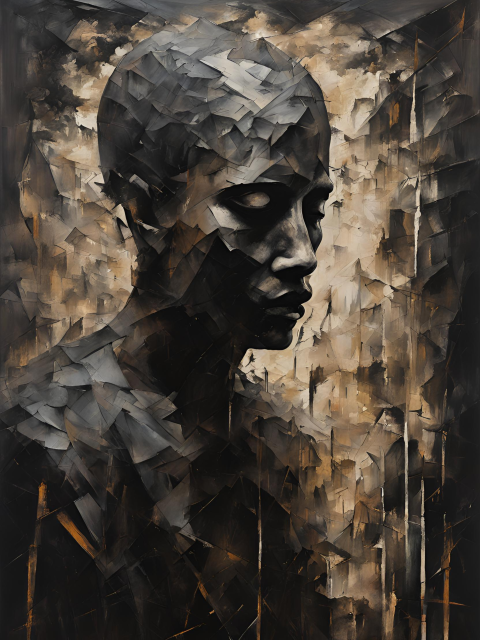
An essay on authorship, intention, and who gets to claim the work.
There is a question currently circling studios, classrooms, and comment threads with the confidence of a verdict already reached: if you did not generate every mark, every pixel, every phrase yourself — is the work truly yours?
It is posed as a test of legitimacy. It carries within it an assumption so deeply embedded that most people do not notice they are making it — the assumption that authorship is a function of manufacture. That to be the author of something, you must be its most granular producer. That the hand that touched the material last, or most, is the hand that owns the meaning.
This assumption is not new. It is not particularly rigorous. And it has been quietly wrong for as long as human beings have organized creative labor.
The question is never only: did you make it? The question is always also: did you mean it?
I. THE DIRECTOR DOES NOT HOLD THE CAMERA
Consider the film director. In the classical auteur tradition — formalized by French critics in the 1950s and refined across a century of cinema scholarship — the director is the author of the film. Not the cinematographer. Not the editor. Not the actor who delivered the line that made an audience weep. The director.
And yet the director, in most productions, touches almost nothing directly. They do not operate the camera. They do not design the costumes. They do not compose the score. They do not build the set. A film crew of two hundred people may labor for months, each one a skilled craftsperson whose individual contributions are real, technical, and irreplaceable. The director watches. The director chooses. The director says: not that, this. More. Again. Stop.
We do not spend significant intellectual energy arguing that Alfred Hitchcock did not author Rear Window because he was not the one who loaded the film stock. We do not contest that Stanley Kubrick shaped 2001: A Space Odyssey because he did not personally construct the models. The question of who generated the raw material is considered almost beside the point. What matters — what has always mattered in the auteur tradition — is vision. The organizing intelligence. The choices that assembled chaos into meaning.
Why should that standard collapse the moment a different kind of tool enters the room?
II. THE PRODUCER IS THE AUTHOR OF THE SOUND
Music offers an equally instructive case, and one perhaps even more culturally intuitive to those skeptical of AI-assisted work.
The music producer does not play every instrument. In many cases, they do not play any instrument on the final recording. What they do is shape everything — the key, the tempo, the arrangement, the texture, the emotional architecture of the track. They select the samples. They decide what stays and what is cut. They hear the potential in a raw recording that no one else has imagined and then they build toward it, decision by decision, until the version that exists in the world is the version they willed into being.
The history of recorded music is, in no small part, a history of producers as authors. Quincy Jones did not write every note of the arrangements that transformed popular music in the latter half of the twentieth century — but no serious listener would dispute his authorship of the sound he created. Rick Rubin famously produces by listening, by responding, by directing energy — not by touching an instrument at all. The DJ tradition, rooted in the creative recombination of existing material, has generated entire genres and cultural movements through the art of selection, sequencing, and remix. Nobody argues that curation is not craft when it produces something that moves people.
In fact, we have a word for the creative act of making something new out of something that already existed: composition. And we have always honored it.
III. THE EDITOR MAKES THE BOOK. THE ART DIRECTOR MAKES THE IMAGE.
The editorial tradition is perhaps the most plainspoken proof that curation is a form of authorship, because it has never pretended otherwise.
A great editor does not write the author’s sentences. What they do is something more surgical and, in its own way, more demanding: they see the work more clearly than the person who created it. They identify what is essential and what is obscuring it. They make the cuts that the author could not bring themselves to make. They ask the questions that reveal what the work is actually trying to say. The finished book, shaped by that editorial intelligence, is legitimately different from the manuscript as received. That difference is authorial labor.
The art director, similarly, does not produce every image in a publication or campaign. They commission. They brief. They direct. They respond. They look at what has been made and say: yes, and — or no, instead — until the visual world they are building coheres into something intentional, consistent, and expressive of a specific point of view. The photographs in a great magazine layout were taken by photographers. The vision of what those photographs would mean, together, in that sequence, at that scale — that belongs to the art director.
These are not marginal or supplementary roles. They are the roles around which entire creative industries are organized, because the people doing this work have been correctly understood to be doing something that requires genuine creative intelligence, refined taste, developed judgment, and a willingness to take responsibility for the final result.
IV. WHAT AUTHORSHIP ACTUALLY IS
If we synthesize what these traditions tell us, the picture becomes clear. Authorship is not primarily about who touched the material. Authorship is about who organized the intention.
It is about who decided what the work would be for. Who determined what it should feel like, mean, convey, or withhold. Who accepted responsibility for the choices that shape the final encounter between the work and its audience. Who, in short, made the work into a statement rather than leaving it as raw material.
The tools that generate raw material — whether they are a camera, a recording studio, a printing press, or an artificial intelligence — are not authors. They do not have intentions. They do not have stakes. They do not stand behind the work and say: this is what I meant. They produce. The human who directs, selects, arranges, refines, and releases the work is the one doing all of those things. That is the author.
Authorship is not located in the hand that made the mark. It is located in the mind that chose the meaning.
This is why the current controversy around AI-assisted work reveals something interesting — not about AI, but about how poorly we have understood authorship all along. The anxiety is real. The stakes are real. But the framework being used to adjudicate legitimacy — the framework that insists the only credible author is the one who generated every element from scratch — has always been a fiction. It was never how creative work actually functioned, even before algorithms entered the picture.
What is new is not the question. What is new is that the gap between the creative decision and the material execution has become visible in a way it was previously easy to ignore.
V. WHAT CURATION REQUIRES
It is worth being precise here, because the argument is not that all uses of AI in creative practice constitute authorship. It is that curation — genuine curation — is not a passive act. It is not pressing a button and accepting whatever appears. It is a sustained exercise of creative intelligence applied to material in motion.
To curate is to know what you are looking for before you find it, and to know when you have found something better. It requires a developed sensibility — a point of view that precedes the work and shapes how the work is received. It requires the capacity to reject, to iterate, to hold the developing work against an internal standard and make decisions about when it is and is not sufficient.
These are not trivial capacities. They are the capacities we spend years developing. They are what formal training in art, design, and creative practice is largely cultivating — not the physical skill to produce a mark, but the discernment to know which marks serve the work and which do not. That discernment does not disappear when the mark is generated by a tool rather than a hand. It becomes more important, because the curator is the only intelligence in the room with something at stake.
An artist who uses generative tools without this discernment — who accepts the first output, who directs nothing, who brings no vision to the encounter — is not really curating. They are delegating. The distinction matters, and it is a distinction that serious artists who work with these tools are acutely aware of. The work of directing the tool, of iterating toward intention, of rejecting what is close but not right — that work is creative labor. It is authorship.
VI. THE VERDICT THE WORK ALREADY CARRIES
Critics of AI-assisted work often arrive at their position through a concern that is, underneath the argument, genuinely honorable: they want to protect the value of human creative labor. They are right to want that. The labor of artists — the years of practice, the developed eye, the cultivated taste, the willingness to be accountable for a point of view — is irreplaceable and important, and it should not be cheapened or falsely replicated.
But the argument that curation is not creation does not protect that labor. It misidentifies where the labor lives. It concedes the most contested ground by accepting a framework in which authorship is located in the most mechanical part of the process — the generation of raw material — rather than in the most human part: the organization of meaning.
If we follow that logic consistently, we would have to conclude that the director is not the author of the film, that the producer is not the author of the sound, that the editor did not shape the book, that the art director contributed nothing essential to the image. History refuses this conclusion. Creative practice refuses it. And every artist who has ever known the difference between a good take and a great one — regardless of who was holding the instrument — refuses it too.
The work carries the verdict of its own authorship. It is legible in the coherence of its choices, the specificity of its vision, the accumulated intelligence of every decision made in service of what the work is trying to say. That intelligence is human. It is the author. And no change in the tools that generate raw material can relocate it.
Curation is creation. It always has been. The only thing that has changed is that we are finally being asked to say so plainly.
Part of The Haus of Legends Educational Series
Creative Literacy for a New Renaissance