Art has a language.
It is a language of line and color, form and space, balance and rhythm, media and technique, composition and perspective, symbolism and expression. t is also a language filled with words that can sometimes feel surprisingly unfamiliar.
What exactly is chiaroscuro? How is value different from tone? What is the difference between shape and form? What makes something figurative, representational, abstract, or nonobjective? What does an artist mean when they talk about negative space, visual hierarchy, impasto, foreshortening, gestalt, sfumato, contrapposto, or atmospheric perspective?
For experienced artists, many of these terms eventually become part of everyday creative vocabulary.
For beginners, students, self-taught creators, designers, photographers, writers, collectors, educators, and people entering art through new technologies such as generative AI, that vocabulary can sometimes feel like an entirely different language.
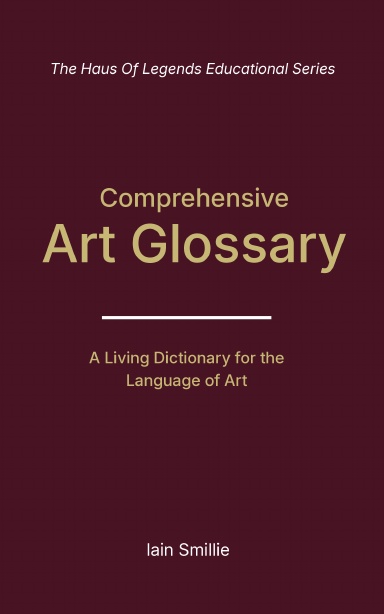
That is why we created Comprehensive Art Glossary: A Living Dictionary for the Language of Art.
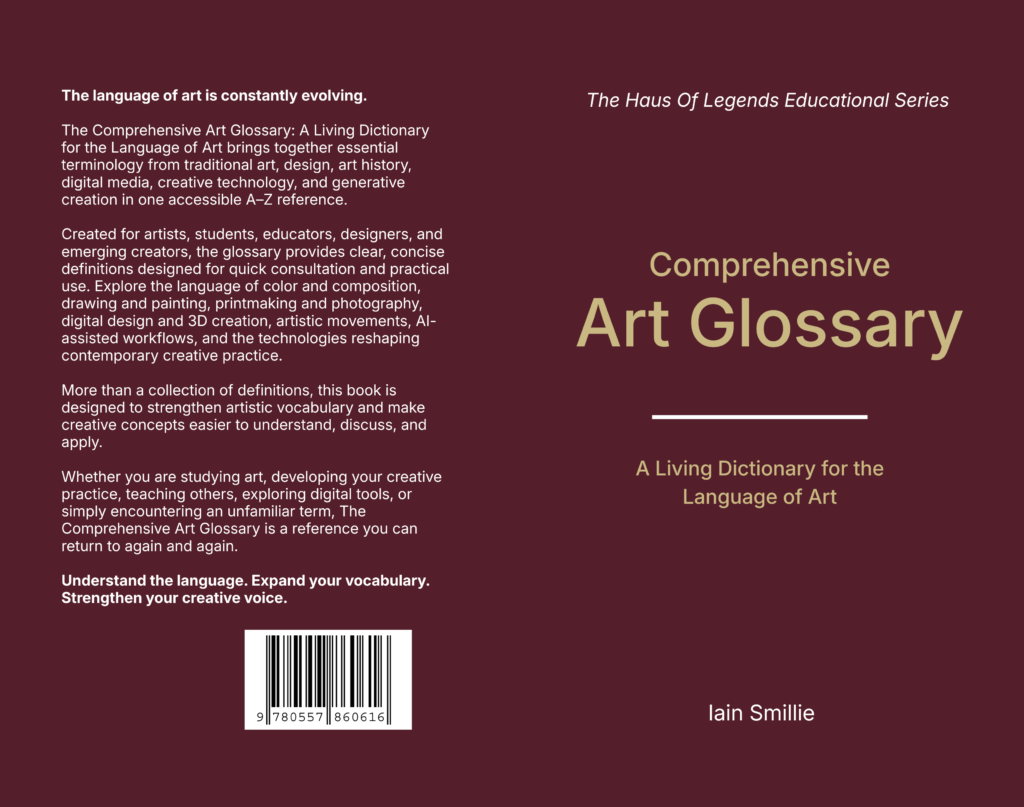
This book is designed to make the vocabulary of art easier to understand, easier to use, and considerably less intimidating. Because learning the language of art does more than help us define words. It gives us better ways to see. Better ways to think. Better ways to describe.
And ultimately, better ways to create.
What Is the Comprehensive Art Glossary?
Comprehensive Art Glossary: A Living Dictionary for the Language of Art is a practical reference designed to help readers understand the terminology used throughout art, design, visual culture, creative education, and contemporary creative practice.
Rather than treating art vocabulary as something that belongs only in classrooms, museums, or academic textbooks, the glossary approaches terminology as a working creative resource.
It is meant to be opened when you encounter an unfamiliar term. Consulted while studying an artwork. Used while writing about art. Referenced while developing a creative project. Kept nearby while learning a new technique. And returned to whenever the language surrounding art becomes unclear. The goal is not simply to tell readers what a word means. The goal is to help make the language itself usable.
Why Does Art Need a Vocabulary?
Human beings often recognize visual qualities long before we know how to describe them.
We may look at an image and say: “It feels balanced.” – “The background looks really far away.” – “The colors seem unusually intense.” – “Everything seems to lead my eye toward the center.” – “The surface looks almost three-dimensional.” – “The figure seems stiff.” – “The image feels chaotic.”
Those observations are already acts of visual analysis. Art vocabulary gives us more precise language for expressing them.
- That “balanced” image may use symmetrical balance.
- The sense of distance may involve atmospheric perspective.
- The intense colors may have high saturation.
- The eye may be guided through visual hierarchy or leading lines.
- The dimensional surface may involve impasto.
- The rigid figure may be contrasted with the relaxed weight shift of contrapposto.
- The apparent chaos may actually be created through deliberate asymmetry, rhythm, repetition, or visual tension.
The vocabulary does not replace what we see. It helps us understand what we are seeing.
From Looking at Art to Reading Art
One of the most powerful changes that happens when someone begins learning art vocabulary is that viewing becomes more active. Instead of simply deciding whether we like an artwork, we begin noticing how it works.
- Where does the eye go first?
- What creates emphasis?
- How has the artist used contrast?
- Are the forms geometric or organic?
- Is the space shallow or deep?
- What role does texture play?
- How does the composition create movement?
- Is the color naturalistic, symbolic, expressive, or decorative?
- What relationship exists between the subject and the surrounding negative space?
- How does the medium influence the final appearance?
- What choices create the mood?
These questions reveal something fundamental about visual literacy: Images are constructed. Even the most spontaneous artwork contains relationships between visual elements. Once we develop the vocabulary to identify those relationships, artworks begin to reveal more of themselves. We are no longer simply looking. We are reading.
Art Vocabulary Is a Creative Tool
Art terminology is often taught as information to memorize. But vocabulary becomes far more useful when it becomes part of creative practice.
- An artist might use vocabulary to diagnose why a composition is not working.
- A photographer might use it to think about depth, framing, contrast, or focal emphasis.
- A designer might use it to communicate hierarchy, scale, proportion, rhythm, and alignment.
- An illustrator might use it to describe line quality, stylization, texture, or form.
- A writer might use it to describe an artwork more accurately.
- A teacher might use it to explain visual concepts.
- A student might use it to understand an assignment or critique.
- A creative director might use it to communicate an idea to a team.
- And an AI image creator might use that same vocabulary directly inside a prompt.
The terminology of art therefore becomes something much larger than a collection of definitions. It becomes a system for communicating visual intention.
The Difference Between Knowing and Understanding
There is an important difference between recognizing an art term and actually understanding how it functions.
You may know that contrast means difference. But understanding contrast allows you to recognize differences in value, color, scale, texture, shape, direction, or form—and understand how those differences affect a composition.
You may know that perspective creates depth. But understanding perspective opens the door to linear perspective, atmospheric perspective, vanishing points, horizon lines, diminution, overlap, spatial recession, and other ways artists construct the illusion of space.
You may know that texture describes surface quality. But understanding texture means recognizing the difference between actual physical texture and visual or implied texture.
That deeper understanding is where vocabulary becomes useful. A definition gives you the term. Understanding gives you the concept. And application turns that concept into a creative tool.
Why a “Living Dictionary”?
Art is ancient. Its language is not static. New materials appear. New technologies develop. New media emerge. Cultural understanding changes. Disciplines overlap. Photography changed the visual arts. Film created new vocabularies of framing, movement, editing, and light. Digital art introduced new workflows and terminology. Three-dimensional software expanded the language of modeling and rendering.
Generative artificial intelligence has introduced still more vocabulary involving prompts, models, generation, iteration, image conditioning, machine interpretation, and creative direction. At the same time, many of the oldest ideas in art remain completely relevant.
- Line still matters.
- Color still matters.
- Composition still matters.
- Form still matters.
- Light still matters.
- The relationship between an image and the person viewing it still matters.
Calling this a Living Dictionary recognizes that the language of art has always developed alongside the ways humans create.
The dictionary exists within that continuing conversation.
Who Is the Comprehensive Art Glossary For?
The glossary is intentionally designed for a wide creative audience.
- It can serve students encountering formal art terminology for the first time.
- It can help beginning artists build a foundation for understanding visual language.
- It can support self-taught creators who may have developed substantial practical skills without ever receiving formal art instruction.
- It can help graphic designers, photographers, illustrators, and digital creators strengthen the vocabulary they use to describe visual decisions.
- It can provide writers, authors, critics, bloggers, and content creators with terminology for discussing artwork more precisely.
- It can support educators and mentors who need concise explanations of creative concepts.
- It can assist creative directors communicating visual ideas across teams and disciplines.
- It can help AI image creators move beyond vague prompting language toward more intentional descriptions of composition, lighting, form, texture, color, space, and visual character.
And it can serve anyone who has ever encountered an unfamiliar art term and thought:
“I know I’ve heard that word before—but what exactly does it mean?”
That is what a good glossary should answer. Without requiring you to read an entire textbook first.
How Do You Use the Glossary?
There is no single correct way to use a reference book.
- You can read it alphabetically.
- You can browse.
- You can jump directly to a word.
- You can use one definition to discover another.
- You can keep it beside you while studying.
- You can consult it while making art.
- You can use it during a museum visit.
- You can reference it while preparing a critique.
- You can use it while writing a prompt.
- You can use it when an instructor, article, book, or video introduces terminology you do not recognize.
And sometimes you can simply open it to a random page and discover something you did not know you needed. That kind of accidental discovery is one of the pleasures of a dictionary. One term leads to another. A word becomes an idea. The idea becomes something you recognize in an artwork. And suddenly a concept that once seemed abstract becomes visible.
Building Visual Literacy
Visual literacy is the ability to interpret, understand, evaluate, and communicate through images. It is becoming increasingly important. We live in an environment saturated with visual information: photography, advertising, film, social media, illustration, graphic design, data visualization, video, digital interfaces, generated imagery, animation, games, and countless other forms of visual communication.
Being visually literate does not simply mean knowing whether an image is attractive. It means being able to examine how the image communicates.
- Why was this composition chosen?
- Why does one element dominate another?
- How is scale being used?
- What does the color communicate?
- Where is the implied movement?
- What relationship exists between figure and ground?
- What kind of perspective is being used?
- How does the material affect our interpretation?
- What creates unity?
- What creates tension?
- What creates emphasis?
Vocabulary gives us the tools to ask those questions with greater precision.
The Language of Art and Creative Direction
The same vocabulary used to analyze existing artwork can also help create new artwork. Suppose someone says: “Make the image more dramatic.” That communicates a goal, but it leaves enormous room for interpretation.
What kind of drama?
- Perhaps the solution is stronger value contrast.
- Perhaps the composition needs more pronounced diagonal movement.
- Perhaps the lighting should become more directional.
- Perhaps the scale relationship needs to become more extreme.
- Perhaps the scene would benefit from greater depth or stronger atmospheric perspective.
- Perhaps the focal point needs more emphasis.
- Perhaps the negative space needs to change.
Vocabulary turns a vague reaction into a series of possible creative decisions. That matters whether the person receiving those instructions is a painter, designer, photographer, illustrator, production team—or an artificial intelligence system.
Art Vocabulary in the Age of Generative AI
Generative AI has created an unusual situation for contemporary creators. People can now produce sophisticated visual imagery before they have developed sophisticated visual vocabulary. That is both extraordinary and challenging.
An image generator may be capable of producing thousands of visual possibilities. But the creator still needs ways to describe what they want, recognize what they are seeing, identify what is working, determine what needs to change, and communicate those changes.
That requires language.
Consider the difference between asking for: “A dramatic portrait.” and describing:
“A tightly framed portrait with strong chiaroscuro, shallow depth of field, asymmetrical composition, restrained color palette, pronounced value contrast, directional side lighting, and subtle atmospheric texture.”
The second instruction does more than add words. It communicates visual decisions. This is one reason traditional art vocabulary has become newly relevant in generative workflows.
The technology may be new.
Many of the visual decisions are not.
Artists have been solving problems involving composition, proportion, color, value, texture, space, perspective, rhythm, balance, movement, light, symbolism, and visual emphasis for centuries. Generative tools do not make that knowledge obsolete.
They give us another place to use it.
From Vocabulary to Intention
There is a progression that occurs as visual vocabulary develops.
- At first: “I like this.”
- Then: “I like the colors.”
- Then: “I like the contrast between the warm foreground and the cooler background.”
- Then: “The warm-cool contrast separates the figure from the environment and strengthens the focal hierarchy.”
Each statement describes the same visual response with increasing precision. That precision matters because creative intention depends on making choices. When we can name what we see, we can begin deciding whether we want it. When we understand why something works, we can experiment with it.
When we recognize a visual relationship, we can change it. Vocabulary transforms instinct into something we can examine. It does not eliminate intuition.It gives intuition another tool.
Learning Without the Gatekeeping
Art vocabulary sometimes carries unnecessary intimidation with it.
Terms may come from French.
- Italian.
- Latin.
- Greek.
- German.
- Japanese.
- Photography.
- Architecture.
- Printing.
- Painting.
- Sculpture.
- Design.
- Philosophy.
- Art history.
- Digital production.
The result can make conversations about art feel far more inaccessible than they need to be. But complicated terminology does not have to require complicated explanations. A person should not need a graduate degree to understand what negative space means. You should not have to feel embarrassed because you do not remember the difference between hue, value, and saturation.
And encountering a term such as tenebrism, trompe-l’œil, or anamorphosis should inspire curiosity—not panic. Every expert once encountered that word for the first time too. A reference book should make the doorway wider. That is part of the purpose of the Comprehensive Art Glossary.
A Reference That Grows With You
Beginners and experienced creators do not necessarily use a glossary in the same way. A beginner may look up a term simply to understand a definition. Later, the same person may return to that term while analyzing an artwork. Later still, they may use the concept intentionally in their own work.
The word has not changed. Their relationship with it has. That makes reference books unusual educational tools. You do not necessarily “finish” them. You grow into them. A term that seems irrelevant today may become exactly the term you need six months from now.
A concept encountered while studying painting may suddenly become useful in photography. A principle learned through graphic design may become valuable when creating an AI image. A word discovered through art history may give you language for something you have intuitively been doing for years.
That is why this glossary is intended to remain useful well beyond the first reading.
Art Is More Than Terminology
No glossary can teach someone everything about art. And vocabulary alone does not make someone an artist.
- Creativity requires curiosity.
- Observation.
- Practice.
- Experimentation.
- Judgment.
- Failure.
- Revision.
- Experience.
- And the willingness to keep looking.
But language helps us think about those experiences. It gives us handles for ideas. It allows one person to communicate a visual concept to another. It connects contemporary creators with centuries of artistic experimentation. And it helps transform something we vaguely sense into something we can consciously investigate. That is what makes vocabulary powerful.
A Dictionary for Creators, Not Just Classrooms
The Comprehensive Art Glossary was created with education in mind, but it belongs just as comfortably in a studio as it does in a classroom.
- Keep it near your sketchbook.
- Keep it beside your computer.
- Use it while developing prompts.
- Bring it into critique.
- Use it while reading about an unfamiliar artist.
- Consult it before visiting a museum.
- Use it when developing a collection.
- Use it when you cannot quite find the word for what you are seeing.
- And use it when curiosity sends you somewhere unexpected.
Reference books are not merely repositories of answers. At their best, they generate better questions.
The Language Belongs to Everyone
Art vocabulary should not be a gate that separates people who “know art” from people who do not.
- It should be a bridge.
- A bridge between seeing and understanding.
- Between instinct and intention.
- Between observation and analysis.
- Between creator and audience.
- Between teacher and student.
- Between history and contemporary practice.
- And increasingly, between human creative intention and the technologies we use to express it.
The terminology may sometimes be technical. The ideas belong to everyone.
A Living Dictionary for the Language of Art
That is ultimately what Comprehensive Art Glossary is intended to be.
- Not a test.
- Not a collection of words you are expected to memorize.
- Not a declaration that there is only one correct way to talk about art.
It is a reference.
- A starting point.
- A learning tool.
- A creative companion.
And an invitation to become more fluent in one of humanity’s oldest forms of communication. Because the more language we have for what we see, the more carefully we can examine it. The more carefully we examine it, the more deliberately we can respond. And the more deliberately we respond, the more intentional our own creative choices can become.
Look closely. Learn the language.
Follow your curiosity.
And create something legendary.