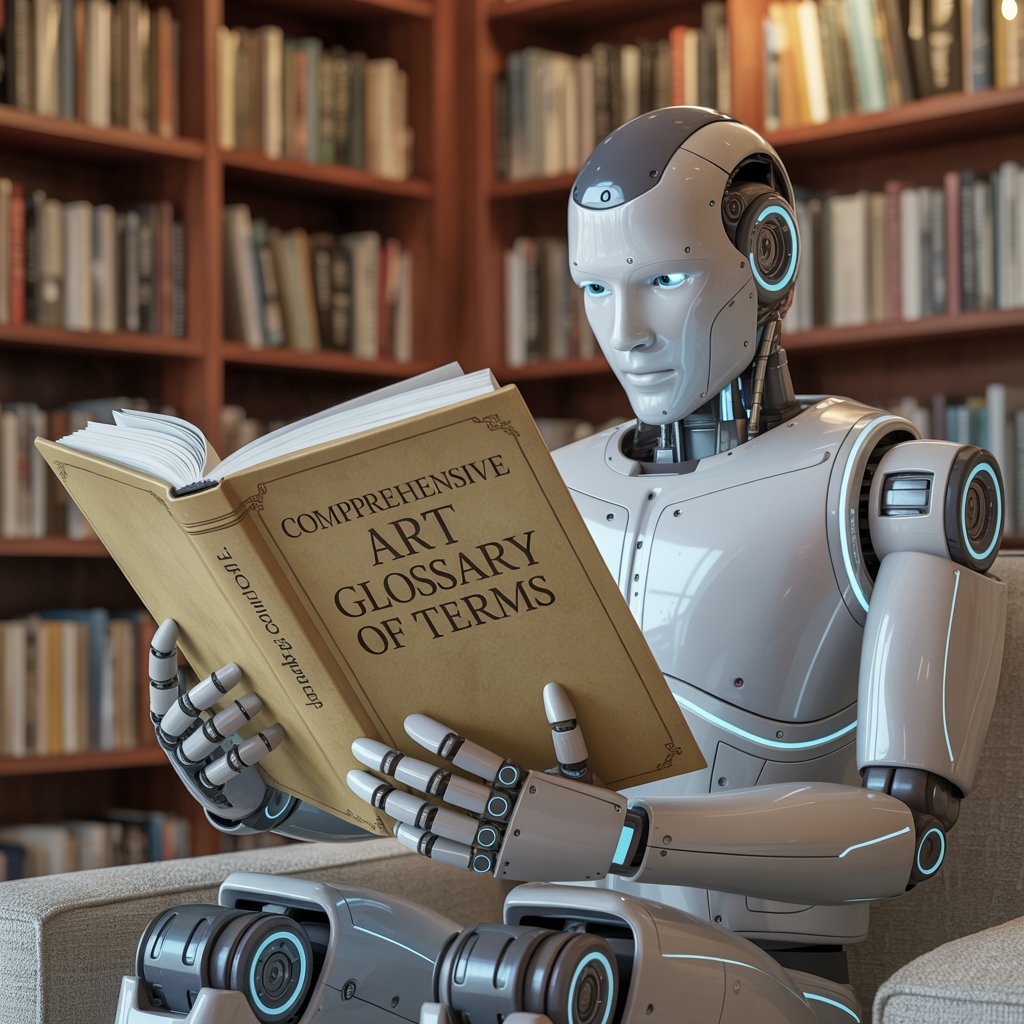
A Comprehansive Art Glossary of Terms in Art, Design & Generative Creation. Available as a FREE download with email sign up in the Haus Educational Resouces Series, or for purchase in Digital Downloads.
A
Abstract Art
Art that does not attempt to represent reality but seeks to achieve effect through shapes, colors, forms, and gestural marks. Emerged in the early 20th century through movements like Cubism and Abstract Expressionism.
Abstract Expressionism
A post–World War II movement centered in New York, emphasizing spontaneous, energetic, and emotional mark-making. Pioneers include Jackson Pollock and Willem de Kooning.
Acrylic Paint
A pigment suspended in fast-drying acrylic polymer resin. Known for flexibility, vibrancy, and ability to be used on diverse surfaces.
Adumbration
A preliminary or faint sketch that outlines the essential features of a composition without full detail or shading.
Aesthetic
A principle or philosophy concerning the nature of beauty and taste in art and design; can be personal, cultural, academic, or conceptual.
AI-Assisted Art
Artwork created with the support of artificial intelligence tools, such as text-to-image models, neural style transfer, GANs, or diffusion models.
Algorithmic Art
Art created through the use of algorithms — a set of rules, processes, or calculations executed by a computer or artist-programmer.
Ambient Light
General, nondirectional light present in a scene. Influences shadow softness, atmosphere, and emotional tone in both photography and illustration.
Analogous Colors
Colors located next to each other on the color wheel (e.g., red, red-orange, orange), often used for harmonious, cohesive palettes.
Anamorphosis
Distorted projection or perspective requiring a specific viewpoint, angle, or reflective surface to be visually resolved.
Anatomical Drawing
Art based on the study of the human or animal body’s internal structure, typically used in figure drawing, sculpture, and medical illustration.
Anthropomorphism
Attributing human characteristics or behavior to non-human beings, objects, or concepts. Used commonly in both surrealism and character design.
Apotheosis
In visual storytelling, the elevation of a figure to divine status — often depicted through radiant forms, rising poses, or symbolic gestures.
Appropriation Art
Art that reuses or recontextualizes existing images, objects, or works to create new meaning; common in Pop Art and Postmodernism.
AR (Augmented Reality) Art
Art that overlays digital content onto the physical world, viewed through devices like smartphones or AR glasses. Blends interactivity and immersion.
Armature
A structural framework used to support material in sculpture, such as clay or plaster — also used metaphorically in narrative construction and concept design.
Art Brut
Also called “raw art,” this term describes art created outside academic tradition — untrained, instinctive, and often made by self-taught or outsider artists.
Art Deco
A popular style from the 1920s–40s characterized by bold geometric shapes, metallics, luxury materials, and elegant, streamlined forms.
Art Nouveau
A 19th-century decorative arts movement featuring organic, flowing lines inspired by natural forms. Associated with artists like Alphonse Mucha.
Assemblage
A sculptural artform made by combining found objects, often incorporating unconventional materials or textures.
Atmospheric Perspective
A technique that creates depth by altering color, clarity, and contrast to suggest distance — objects appear lighter and less defined as they recede.
Automation Bias (in AI Art)
The tendency to trust machine-generated output without sufficient oversight or critique — a crucial idea in ethical and intentional prompting.
B
Background (Visual Arts)
The part of an artwork that appears farthest from the viewer; helps establish spatial depth and often supports the subject without dominating it.
Baroque
An art movement (c. 1600–1750) characterized by dramatic use of light and shadow, emotional intensity, rich detail, and dynamic compositions. Associated with artists like Caravaggio and Bernini.
Bas-Relief
A type of sculpture in which figures are slightly raised from a flat background. Common in architecture, monuments, and decorative friezes.
Bauhaus
A German design school (1919–1933) that blended art, craft, and industrial design. Known for minimalist geometric forms, functionalism, and interdisciplinary learning.
Bicubic Sampling (AI Imaging)
A smooth interpolation method used to scale images up or down in digital environments, preserving more visual quality than nearest-neighbor methods.
Biennial (Art Exhibition)
A large-scale international art exhibition that takes place every two years, often reflecting contemporary trends through curated installations and projects.
Binary Image
An image composed of only two possible values (e.g., black and white), commonly used in early digital rendering, logo design, and certain kinds of pattern generation.
Bleed (Printing)
The area outside the document boundary used to ensure images or color extend all the way to the edge when trimmed.
Body Proportion (Figure Drawing)
A method for measuring and depicting the human body accurately using canonical ratios (e.g., the “eight heads” model in classical art).
Bokeh
The visual quality of out-of-focus blur in a photograph or image, typically appearing as soft circles of light. Used for atmospheric depth and emotional tonality.
Brushwork
The visible marks left by an artist’s brush on a surface. May be smooth or expressive, dependent on style and medium.
Burnishing (Pencil & Pastel)
A technique that uses pressure to create a polished, waxy surface, blending pigment and reducing texture.
Byzantine Art
A style of late antiquity and early medieval art known for mosaic decoration, gold backgrounds, religious iconography, and flattened, ethereal figures.
Bytebalm (AI Neologism)
Creative term sometimes used to describe AI-generated ‘healing’ overlays or blending effects, often tied to generative smoothing or texture transitions.
C
Canvas
A textile surface (often cotton or linen) primed and prepared for painting, commonly stretched over a wooden frame. Traditional support for acrylic and oil paint.
Caricature
A drawing or rendering that exaggerates distinctive features of a person or subject for humorous or satirical effect.
Chiaroscuro
A technique that uses strong contrasts between light and dark to create the illusion of volume, depth, and three-dimensionality. Used prominently by Caravaggio and Rembrandt.
Chromatic Aberration
A visual artifact in photography and digital rendering where colors fray or distort at the edges due to lens or simulation errors. Sometimes used intentionally in digital art.
Collage
An art-making technique that assembles materials such as paper, photographs, fabric, and paint onto a single surface to create a layered composition.
Color Theory
A body of principles used to understand color mixing, relationships, emotional impact, and visual harmony. Includes concepts like complementary, analogous, and triadic color schemes.
Composition
The arrangement or organization of elements within an artwork. A strong composition guides the viewer’s eye and reinforces meaning or emotion.
Concept Art
Visual development artwork created to establish the look, mood, and worldbuilding of films, games, or animation before production begins.
Constructivism
An early 20th-century Russian movement focused on geometric abstraction, industrial materials, and socially engaged art. Art was seen as a tool for building a new society.
Contrast (Visual Design)
The difference between two elements that makes them distinguishable — such as light vs. dark, smooth vs. rough, or bold vs. subtle color.
Contour Drawing
A line drawing technique that outlines the edges and surface ridges of an object without shading or detail, used for observational practice.
Cubism
An early 20th-century movement led by Picasso and Braque, presenting multiple viewpoints of a subject simultaneously through abstraction, fragmentation, and geometric forms.
Curatorial Practice
The professional and creative discipline of organizing, contextualizing, and presenting artwork in exhibitions or collections.
Cybernated Art
Art created through or affected by cybernetic systems, including robotics, algorithmic inputs, and real-time digital interaction.
Cyberpunk Aesthetic
A science-fiction-influenced visual theme featuring neon-drenched cityscapes, urban decay, technological augmentation, and dystopian futurism.
CycleGAN
A type of generative adversarial network that can translate images from one domain to another (e.g., turning photographs into paintings without paired training data).
D
Dadaism (Dada)
An early 20th-century avant-garde movement that rejected logic, reason, and aesthetic norms in response to World War I. Embraced absurdity, chance, readymades, and anti-art ideas. Associated with Marcel Duchamp.
Dappled Light
A visual effect where sunlight filters through leaves or other surfaces, creating broken, scattered patches of light and shadow — commonly used in Impressionist paintings.
Decalcomania
A transfer technique used in Surrealist and mixed media art, where paint or ink is pressed between surfaces to create unpredictable patterns or textures.
Decentralized Art
Art created, displayed, or traded through blockchain-based systems. Includes NFTs, crypto art, and distributed digital ownership.
Deconstructivism
A late 20th-century architectural and visual style characterized by fragmentation, non-linear design, and the dismantling of traditional structural rules. Related to postmodern thinking.
Depth (Visual Arts)
The perception of spatial distance in a composition. Can be achieved through perspective, overlapping, value contrast, scale, or atmospheric effects.
Diffusion Model
An AI architecture used for image generation (e.g., Stable Diffusion, Midjourney). It creates images by iteratively denoising random noise toward a guide prompt.
Diptych / Triptych
A set of two (diptych) or three (triptych) connected artworks intended to be viewed together, often exploring complementary or sequential themes.
Directional Light
Lighting that comes from a single, fixed source — casting defined shadows and highlights used to sculpt form and create mood.
Direct Painting (Alla Prima)
A technique in which paint is applied wet-on-wet in a single session without layering or drying in between, often used in oil portraiture.
Discordant Color Scheme
A bold, jarring mix of colors used intentionally to create tension, energy, or emotional impact in a composition.
Displacement Map (3D)
A grayscale texture used to deform the surface of a 3D model based on height information, creating realistic terrain, skin detail, or fabric wrinkles.
Documentary Photography
Authentic imagery created to record real events, people, and environments, often with a focus on social, cultural, or political narratives.
DPI (Dots Per Inch)
A measurement of image resolution in printing. Higher DPI values produce more detailed, professional-quality prints.
Drapery Study
A classical drawing exercise focused on capturing the folds, shadows, and gestures of fabric — essential for historical figure painting.
Dreamcore
A contemporary aesthetic combining nostalgic, liminal, and dreamlike imagery — often featuring surreal lighting, empty spaces, blur effects, and identities in flux.
Dynamic Composition
A layout that conveys motion, energy, or imbalance — often achieved through diagonal lines, asymmetry, or contrasting elements.
E
Easel Painting
A painting created on a portable support (often canvas or panel) and produced on an easel, as opposed to mural or wall-based artwork.
Edge (Visual Design)
The boundary between different areas of value, color, or form in an image. Edge quality (soft, hard, lost, or implied) influences focus and spatial depth.
Edition (Printmaking / NFT)
A group of identical or near-identical prints or digital artworks produced in limited quantity. In traditional printmaking, each copy is signed and numbered; in NFTs, the edition number is encoded on-chain.
Eidetic Image
A highly vivid visual memory or mental image used by artists to reconstruct scenes or details from imagination.
Embossing
A printing or sculptural technique that creates raised or recessed relief on a surface, often used in bookbinding, metalwork, or 3D texture design.
Emotional Line (Drawing)
Lines used to evoke feeling or psychological tone—e.g., sharp, jagged lines for distress, flowing curves for calm, etc.
Environmental Art
Art created to interact with, enhance, or comment on the natural environment; includes land art, eco-art, and site-specific installations.
Ephemeral Art
Artworks designed to be temporary—such as performance art, sand mandalas, ice sculpture, or digital projections that disappear after use.
Etching
An intaglio printmaking technique in which lines are incised into a metal plate using acid, then inked and printed to produce multiple impressions.
Exquisite Corpse
A collaborative drawing or writing game created by the Surrealists in which multiple participants contribute to a composition without seeing the previous parts.
Expressionism
An art movement that emphasizes internal emotion over external reality, often through bold colors, dramatic brushwork, and distorted forms. Associated with artists like Edvard Munch and Egon Schiele.
Extended Reality (XR)
An umbrella term for technologies that blend physical and virtual environments, including AR (Augmented Reality), VR (Virtual Reality), and MR (Mixed Reality).
Eye Path (Composition)
The intentional direction an artist uses to guide a viewer’s gaze through a piece using line, shape, value contrast, or implied motion.
Eyeshine (Digital Lighting)
The use of reflective highlights in the eyes of a subject to create realism, emotion, or focal emphasis in portraiture and animation.
Ethical Prompting (AI Art)
The practice of thoughtfully crafting prompts to avoid copyright infringement, bias reinforcement, harmful stereotypes, or unethical data use.
Etherpainting (AI Neologism)
A speculative term used to describe paintings generated in a fully virtual environment without physical material—visualized via blockchain or VR.
F
Fauvism
An early 20th-century movement known for its bold, non-naturalistic colors and expressive energy. Associated with artists like Henri Matisse and André Derain.
Figure Drawing
The artistic practice of drawing the human body from life or reference. Focuses on anatomy, proportion, gesture, and expressive form.
Filmic Lighting
A cinematic lighting approach that recreates the dramatic, directional, often moody illumination found in film — used in digital painting and 3D rendering for emotional effect.
Filter (Digital Art)
An effect applied to an image or layer in software to modify appearance — such as blur, sharpen, grain, noise, or color correction.
Flat Color
An area of uniform color without gradients or shading. Used frequently in graphic art, illustration, posters, or cel animation.
Foreshortening
A drawing technique that depicts an object or form as compressed when viewed at an angle, creating the illusion of depth and perspective.
Found Object Art (Objet Trouvé)
Art that incorporates everyday objects presented in aesthetic or conceptual contexts. Popularized by Surrealists and Modernists such as Duchamp.
Fractal Art
Artwork generated using fractal mathematics — recursive patterns and self-repeating geometries — often created with software or code.
Frame Rate (Animation / Video)
The number of frames or images displayed per second. Lower frame rates produce choppier motion; higher frame rates produce smoother action.
Fresco
A method of mural painting in which pigment is applied to wet plaster, allowing colors to become part of the wall surface as it dries. Used in Renaissance art (e.g., Michelangelo’s Sistine Chapel).
Fugue (Visual Rhythm)
A term borrowed from music to describe complex repetition and variation within visual art — especially in abstraction and digital motion design.
Fusion (Mixed Media / AI)
A hybrid approach blending multiple mediums or formats (e.g., analog + digital, photography + painting, AI generation + hand rendering) into a single composition.
Futurism
An early 20th-century movement originating in Italy that glorified speed, technology, machinery, and modernity. Feature frenetic energy and motion blur.
Fuzzy Logic (AI)
A non-binary reasoning model used in some generative systems to recognize partial truths, influencing decision-making in algorithms and visual variation.
FX (Visual Effects)
Short for “effects,” refers to simulated or enhanced visual elements added during post-production in film, animation, and video-based media.
G
GAN (Generative Adversarial Network)
A type of AI model where two neural networks — a generator and a discriminator — are trained against each other to create realistic outputs such as images, text, or sound. Used in many AI art systems.
Gamut (Color Theory)
The full range of colors that can be captured, displayed, or printed by a particular device or medium. Different gamuts apply to RGB, CMYK, and display screens.
Geometric Abstraction
A style of visual art that uses simple geometric shapes, often in non-representational compositions, to evoke conceptual or emotional effect. Seen in movements like Suprematism and De Stijl.
Gestalt (Design Psychology)
A theory asserting that the human mind perceives unified patterns and wholes rather than disconnected parts. Applied in composition, UX, and visual identity design.
Gesture Drawing
A quick, loose drawing exercise used to capture the essential movement, flow, and energy of a figure or form, rather than detailed anatomy.
Giclée Print
A high-resolution, archival inkjet print commonly used for fine art reproduction. Known for accuracy, color fidelity, and longevity.
Glaze (Painting)
A transparent layer of color applied over a dry layer of paint to modify hue, depth, or luminosity — a key technique in oil painting.
Glitch Art
A digital art form that embraces errors and distortions in software, data corruption, or image processing to produce unexpected aesthetic results.
Glyph (Typography)
A symbol, character, or mark that is part of a typeface or written system — includes letters, punctuation, icons, and ligatures.
Gold Leaf (Gilding)
A thin sheet of gold applied to surfaces in painting, sculpture, and design to enhance texture and visual richness. Used in icons, religious art, and luxury design.
Gradient Map (Digital Art)
A method for assigning color to the grayscale values of an image, allowing quick and dramatic recoloring for mood, emphasis, or surreal effect.
Graffiti Art
A form of visual expression created in public spaces using spray paint, markers, stencils, or stickers — linked to street culture, activism, and hip-hop communities.
Graphic Novel
A narrative work in comic-strip format, bound like a book, blending literature and sequential art. Known for visual storytelling and emotional depth.
Grid (Design Layout)
A structural system of lines that organizes spatial relationships and alignment in graphic design, architecture, or UX/UI.
Grotesque (Art & Typography)
In art: strange, distorted, or hybrid human/animal figures, common in medieval decoration. In typography: early sans-serif typefaces known as “grotesques.”
GUI (Graphical User Interface)
The visual interface through which users interact with software. Critical in digital art tools, game design, and generative workflows.
Guthrie Shifts (AI Terminology)
A conceptual term used to describe shifts in style or tone caused by dataset bias or training variance in AI-generated art.
H
Habitus (Art Sociology)
A concept introduced by Pierre Bourdieu describing how social and cultural conditions shape an individual’s tastes, aesthetics, and creative habits — often reflected in art history and criticism.
Hatching (Drawing)
A shading technique using closely spaced parallel lines to convey light, form, and volume. Cross-hatching uses intersecting lines for deeper shading.
High Renaissance
The peak of Renaissance art (c. 1490–1520), marked by mastery of human anatomy, perspective, and balanced composition. Associated with Leonardo da Vinci, Michelangelo, and Raphael.
High-Resolution Model (AI Art)
An AI model trained or configured to produce detailed images suitable for large prints, often using super-resolution techniques.
Hierarchy (Visual Design)
The arrangement of elements in a composition to guide viewer attention. Achieved through contrast, size, color, and placement.
Histogram (Photography)
A graphical representation of tonal values in an image, used to evaluate exposure and dynamic range.
Hue (Color Theory)
The attribute of color defined by its dominant wavelength, such as red, blue, or yellow — distinct from value or saturation.
Hybrid Art
Artwork that blends multiple media or processes (e.g., analog + digital, physical + virtual, hand-drawn + AI-assisted) into a single integrated creative form.
Hyperrealism
A genre of art in which the rendering is so detailed that it exceeds the clarity of a typical photograph; often evokes uncanny precision.
Hyperpalette (AI Art Neologism)
A term used to describe color choices that exceed natural RGB limitations, created through AI blending or data-driven gradients.
Hypnagogic Imagery
Visual content inspired by the transitional state between wakefulness and sleep — often used in dreamcore aesthetics and abstract animation.
Horizon Line (Drawing & Painting)
The distant line where sky meets land or sea; crucial for perspective drawing and establishing eye level in compositions.
HSL Slider (Digital Design)
A tool for adjusting Hue, Saturation, and Lightness in editing software, commonly used in color grading and digital painting.
Human-in-the-Loop
A process in AI-assisted creation that involves iterative feedback and correction from a human artist during or after generation.
Hybrid Prompt (AI Art)
A structured prompt combining multiple modes of description (e.g., narrative + style + technical settings) designed to yield more precise outputs.
I
Iconography
The visual symbols, motifs, and themes used in art to convey specific meanings, especially in religious, historical, and cultural contexts.
Illuminated Manuscript
A handwritten book decorated with gold leaf, ornate initials, or miniature illustrations — common in medieval Europe.
Impasto
A painting technique where paint is applied thickly, creating visible texture and brushstrokes. Common in Impressionism and Expressionism.
Impressionism
A 19th-century movement focused on the effects of light, color, and atmosphere rather than precise detail. Key artists include Claude Monet and Mary Cassatt.
In Situ (Art Installation)
Latin for “in place,” referring to artwork created or displayed in the location for which it was intended — often site-specific or environmental work.
Incidence Light (Lighting Design)
The direction and intensity of light as it reaches a surface, affecting shadow, color, and rendering in both physical and digital art.
Industrial Design
The discipline of designing products, objects, or systems for mass production — balancing form, function, and user experience.
Infographic
A visual representation of information, data, or knowledge, designed to make complex ideas accessible and appealing through text, iconography, and layout.
Interactive Art
Art that requires participation from a viewer or user to be completed or experienced. Includes touch-based installations, AR works, and generative web pieces.
Interpolation (Digital Media)
A mathematical method for filling gaps or creating intermediate values between data points. Used in animation, upscaling, and image synthesis.
Intaglio (Printmaking)
A printmaking method where lines are incised into a metal surface, filled with ink, and pressed onto paper. Includes engraving, etching, and drypoint.
Iterative Design
A cyclic process of prototyping, testing, analyzing, and refining a project. Found in software, games, UX design, and AI art workflows.
Iterative Prompting (AI Art)
The process of successively refining prompts to improve or evolve generated images. Often used in dialogue with AI models to shape style and intent.
Isolation (Visual Composition)
A compositional technique that emphasizes a subject by placing it alone in the frame, often creating emotional or conceptual impact.
Isotype (Pictorial Language)
A visual system developed by Otto Neurath in the 1920s using simplified icons to communicate information quickly and universally.
Italian Renaissance
A revival of classical art, humanism, and realism in 14th–16th century Italy, marked by mastery of anatomy, perspective, and natural light.
J
Japonisme
A late 19th-century European art movement inspired by Japanese prints, textiles, and aesthetics. Influenced Impressionists and Post-Impressionists like van Gogh and Degas.
Juxtaposition
The placement of two or more contrasting elements—such as colors, objects, or concepts—side by side to highlight difference, tension, or meaning. Used in fine art, film, and AI collaging.
JPEG (Joint Photographic Experts Group)
A commonly used digital image format that compresses photographic content using lossy compression, making it smaller but sometimes less sharp than PNG or TIFF.
Jugendstil
The German-Austrian form of Art Nouveau, known for organic lines, whiplash curves, and decorative natural motifs. Literally “Youth Style.”
Justice-Oriented Art
Creative work aimed at addressing social issues such as equity, human rights, climate justice, and representation. Often uses public media, activism, or collaborative platforms.
J-Curve Composition
A dynamic compositional layout that leads the eye through a curve resembling the letter “J,” often used in landscapes and figure design for fluid visual movement.
Joint Attention (AI & Cognitive Art)
A psychological and visual phenomenon in art and interface design where viewers engage with a shared focus—either between characters or between viewer and image.
Journal Sketching
The practice of keeping a visual journal using sketches, notes, and observations. Often used by illustrators, designers, and conceptual artists to document ideas in progress.
Jump Cut (Video / Editing)
A sudden shift between two camera angles or moments in a video that disrupts continuity. Used stylistically in filmmaking and time-based digital art.
K
Kaleidoscopic Imagery
Visual compositions featuring symmetrical, shifting, or mirrored patterns resembling those produced by a kaleidoscope — commonly used in digital art, animation, and AI pattern generation.
Kinetic Art
Art that incorporates real or apparent movement, either by mechanical means, natural forces (such as wind), or viewer interaction. Famous in mid-20th-century modernism.
Kirigami
A variation of origami that involves both cutting and folding paper to create complex sculptural forms or pop-up structures. Used in installation and architectural modeling.
Kitsch
Artwork or objects considered overly sentimental, showy, or lowbrow, often due to mass appeal or commercialization. Sometimes reclaimed ironically in postmodern and pop culture art.
Knotwork Art
Decorative interlacing patterns often associated with Celtic, Norse, or Islamic traditions. Found in manuscripts, tattoos, and generative pattern-making.
Koji Aesthetic (AI Art Term)
A visual style influenced by imperfection, oxidation, fermenting textures, and the warm organic hues of traditional Japanese materials — emerging in text-to-image subgenres.
Kōan (Zen Art)
A paradoxical question or statement used to provoke deeper thought or enlightenment, often reflected in conceptual or meditative artworks.
Korean Minhwa
Traditional Korean folk painting style known for vibrant colors, stylized animals, and symbolic storytelling — now often reinterpreted in contemporary and AI-assisted art.
Kubrick Stare (Film/Art)
A visual trope popularized by director Stanley Kubrick, referring to a slow zoom into a character staring directly at the camera with intense expression. Used to evoke unease, psychology, or tension in visual media and portraiture.
Kulmination Layer (AI Neologism)
A speculative prompt-structure concept referring to the final stage where all layers of a generative sequence converge — often used for finishing passes or conceptual polish.
L
Lacquerware
A decorative art form using multiple layers of resin or lacquer to create a polished surface, often adorned with gold leaf or inlaid designs. Prominent in East Asian craft traditions.
Landscape (Genre)
A category of visual art depicting natural scenery such as mountains, forests, rivers, and skies. Can range from realistic to abstract and symbolic interpretations.
Life Drawing
The practice of drawing or painting from live, nude models, focusing on anatomy, posture, light, and the expressive qualities of the human figure.
Light Source (Visual Priority)
In both physical and digital art, the origin and direction of the primary light defines form, mood, and shadow. Essential in realism and stylized lighting.
Line Quality
The expressive characteristics of drawn or painted lines, including thickness, texture, flow, energy, and clarity — a fundamental aspect of style.
Liminal Space
A visual or conceptual zone between states, often depicted as eerie, empty, or transitional (e.g., empty malls, abandoned hallways). Popular in dreamcore and digital surrealism.
Linocut
A relief printmaking technique where a design is carved into linoleum, inked, and printed. Known for bold contrast and graphic simplicity.
Lithography
A printmaking method using a flat stone or metal plate, where oil-based ink adheres to drawn areas but repels water — allows for fine detail and tonal range.
LOOP Animation
A repeating animation sequence with seamless beginning and end, often used for GIFs, web animations, or generative motion art.
Lost and Found Edges
A technique where edges of a subject blend into their surroundings or dissolve into shadow — used to create atmosphere, depth, or ambiguity.
Low Fidelity (Lo-Fi)
A stylistic choice favoring rough, analog, or imperfect qualities — visible grain, pixelation, tape hiss — often evoking nostalgia or DIY aesthetics in visual work.
Luminosity
The inherent brightness or radiance of a color or visual element. In digital art, referred to by channels in HSL or LAB color models.
LUT (Look-Up Table)
A preset used in photography and film to apply a specific color grade or visual tone across footage or images.
Lyricism (Art & Writing)
The expressive, poetic quality of visual or written work — emphasizing beauty, flow, emotional depth, and sensitivity rather than direct narration or realism.
Latent Space (AI Art)
The abstract representational “space” inside machine learning models where meaning emerges through numerical relationships. Artists explore latent space through prompt variation and sampling.
Layer Mask (Digital Workflow)
A non-destructive way to hide or reveal parts of a layer in Photoshop or similar software, essential for selective effects and hybrid textures.
M
Macro Photography
Photography that captures extreme close-up images, often of small subjects like insects or textures, revealing fine details invisible to the naked eye.
Maquette
A small-scale model of a sculpture or architectural project, used to test form, structure, and composition before full-size production.
Marbling
A decorative technique that creates swirling, organic patterns on paper or surfaces by floating ink or paint on water and transferring it via contact.
Matte Painting
A painted or digitally created backdrop used in film and animation to simulate large or complex environments that don’t physically exist.
Medium (Plural: Media)
The material or tool used to create art — such as oil paint, charcoal, clay, or digital pixels. In AI, refers to the simulated form or style chosen (e.g., “oil on canvas” prompt).
Memento Mori
A symbolic artwork designed to remind the viewer of death and the transient nature of life; often featuring skulls, clocks, or extinguished candles in classical art.
Metaverse Art
Digital art created for or within immersive virtual environments, including 3D galleries, VR sculpture, and avatar-based performance spaces.
Mixed Media
Artwork combining multiple mediums or materials — such as collage, paint, found objects, and digital elements — to create layered meaning.
Mode Collapse (AI Art Term)
A problem in generative models where output becomes repetitive or lacks variation due to insufficient diversity in training or over-optimization.
Modularity (Design)
A system-based design principle where elements can be rearranged or combined in different ways — used in UI/UX, sculpture, architecture, and coding-based art.
Monochrome
An artwork created using only one color or hue, often with variations in value or texture. Used for harmony, minimalism, or mood.
Montage
The combination of multiple images, footage, or elements into a single composition. In AI, often refers to layered or multi-image prompts.
Motif
A recurring visual element or symbol in a work of art, contributing to thematic cohesion or emphasis.
Multimodal AI
AI systems capable of processing and generating across multiple forms — such as text, images, audio, and 3D assets in the same workflow.
Mural
A large-scale artwork painted or installed on walls, ceilings, or architectural surfaces, often public and communal in nature.
Muse
A source of inspiration — a person, idea, place, or creative force that guides or ignites the artistic imagination.
Mutation Factor (AI Art Neologism)
A conceptual variable describing how drastically an AI model alters a prompt or random seed during variation generation.
N
Narrative Art
Art that visually tells a story, whether through sequential scenes (like in comics or tapestries) or a single symbolic composition. Found in everything from cave paintings to graphic novels.
Naturalism
A style of art that aims to depict subjects as they appear in nature, without idealization or distortion — distinct from realism in its focus on lifelike detail.
Negative Space
The area in an artwork that is unoccupied by objects or subjects. Skillful use of negative space enhances clarity, balance, and impact in a composition.
Neoclassicism
An 18th-century movement inspired by Ancient Greek and Roman art. Emphasizes simplicity, symmetry, and idealized figures. Associated with Jacques-Louis David and Ingres.
Neon Noir
A visual aesthetic that blends film noir’s shadows and mystery with neon-drenched, futuristic environments. Often seen in cyberpunk, graphic novels, and digital art.
NFT (Non-Fungible Token)
A blockchain-certified digital asset used to verify ownership of digital art, collectibles, and virtual objects. Has redefined the concept of scarcity in digital art.
Noise (Digital Image)
Visual static or grain appearing in low-light or low-resolution images. In AI, refers to the raw randomness that diffusion models iteratively refine into images.
Non-Objective Art
Art that is purely abstract and does not depict recognizable objects or subjects. Focuses on form, color, and composition.
Nouvelle Vague (New Wave)
A cinematic and artistic movement from 1950s–60s France, emphasizing unconventional editing, location shooting, and personal expression. Influenced video art and modern visual culture.
Nubuck Palette (AI Prompting)
A descriptive color term used in AI art prompts, evoking matte-finished, suede-like tones — soft greys, browns, and muted earth hues.
Numerical Aesthetics
A term used in generative and data art referring to compositions derived from math, algorithms, or coded systems — such as fractal or parametric art.
NURBS (3D Modeling)
Short for “Non-Uniform Rational B-Splines” — mathematical curves used to create smooth, flexible surfaces in 3D design and animation.
Nychthemeron (Conceptual Art Term)
Refers to a full 24-hour cycle, often used in time-based or environmental art to indicate works that transform over a full day-night period.
O
Objective Drawing
Drawing based on direct observation of the subject matter, with emphasis on accuracy, proportion, and realistic representation.
Octane Render
A GPU-accelerated rendering engine used in 3D art, motion graphics, and VFX for creating photorealistic visuals with real-time lighting effects.
Oil Paint
A slow-drying paint made by suspending pigments in oil (often linseed). Favored for its rich colors, blending quality, and durable finish.
Opaque
A quality of paint or material that blocks light from passing through, covering underlying layers completely.
Op Art (Optical Art)
A visual art movement from the 1960s that uses optical illusions, repetitive patterns, and graphic contrast to create the illusion of motion or vibration.
Opalescent Lighting (AI / Digital Design)
A term describing glowing, multi-colored lighting effects with soft gradients — often used in digital painting and rendering for ethereal, reflective atmospheres.
Open Composition
A composition in which elements seem to extend beyond the boundaries of the frame, suggesting space, dynamism, and continuity.
Optimized Prompt (AI)
A prompt refined to maximize clarity, precision, and quality of generated output while minimizing unwanted noise, clipping, or model confusion.
Ornamentation
Decorative detail or surface embellishment added to objects or architecture, often with symbolic or aesthetic significance.
Orthographic Projection (3D Design)
A method for visually representing 3D objects in 2D without perspective distortion — used in technical drawing and model sheets.
Outpainting (AI Imaging)
An AI technique that extends an image beyond its original borders, creating new surrounding detail in matching style or content.
Outsider Art (Art Brut)
Work created outside the traditional boundaries of the art world, often by artists without formal training or by individuals with unconventional life experiences.
Overlay (Compositing)
In digital art, a blend mode or layer that adds texture, lighting effects, or detail on top of other layers without fully obscuring them.
Overpainting
Adding new layers of paint or texture over a previous image — used in restoration, remixing, and mixed media workflows.
Oxidation Color Palette
A color range inspired by rust, aged metal, moss, and patina — popular in environmental concept art and AI texture prompts.
P
Palette
The range of colors selected by an artist for a particular artwork or series. Also refers to the physical surface on which paints are mixed.
Palimpsest
An artwork or surface that has been erased and reused, leaving traces of previous marks. Symbolically refers to layered ideas, memories, or identities.
Panorama
A wide-angle representation of physical space, often created by stitching multiple images. Used for landscapes, VR, and immersive scene design.
Parallax (Digital / Film)
The perception of depth created when foreground and background elements move at different speeds. Used in animation, game environments, and film compositing.
Pastel
A dry art medium made from pure pigment and a binder, often associated with soft blending and delicate color transitions.
Pattern Recognition (AI / Neurology)
The ability of both human perception and AI systems to detect and interpret recurring shapes, styles, or motives in visual data.
Pentimento
Visible traces of earlier work or changes within a painting, revealing the artist’s process. From the Italian “repentance.”
Photobashing
A digital technique combining photography and painting to quickly create visual concepts. Common in concept art, matte painting, and AI-enhanced workflows.
Photorealism
A visual style that seeks to replicate the appearance of a high-resolution photograph with meticulous detail. Popular in CGI, AI rendering, and hyperrealist art.
Pigment
The substance that gives color to paint, ink, or other media. Can be organic, mineral-based, or synthesized.
Pixel Art
A digital art form where images are created and edited at the pixel level, often associated with retro gaming and lo-fi aesthetics.
Planar Design (Drawing)
The simplification of complex forms into flat planes, often used to study how light interacts with volume before rendering details.
Pointillism
A technique where tiny dots of pure color are applied in patterns to form images when viewed at a distance. Associated with Georges Seurat and Neo-Impressionism.
Polymorphism (Generative Art)
In code-based art, the ability of a system to present multiple forms or behaviors based on changing inputs or conditions.
Portfolio
A curated collection of an artist’s best work, used for exhibition, client pitches, or professional development.
Pose-to-Prompt (AI Workflow)
A method where the artist uploads a pose reference (e.g., a photo or sketch), and AI builds an image or variation while preserving pose structure.
Post-Processing
Editing or enhancing images after they’re created — adjusting color, contrast, composition, effects, etc. Essential in digital and AI-assisted workflows.
Postmodernism
A late 20th-century movement characterized by self-awareness, parody, fragmentation, irony, and deconstruction of traditional narratives and forms.
Proportion
The relationship of size between different parts of a composition. Essential in figure drawing, architecture, and character design.
Prompt Engineering
The method of crafting, refining, and testing prompts to achieve desired output in generative AI systems. Combines linguistic clarity, context, and creative iteration.
Psychogeography (Art & Design)
The study of how physical environments affect emotions and behavior — used in conceptual art, urban design, and immersive installation.
Q
Quadratura
A technique used in Baroque ceiling painting that employs illusionistic architectural perspective to make painted structures appear as extensions of real ones.
Quadriptych
An artwork made up of four separate panels intended to be displayed together as a unified composition. Common in altarpieces and contemporary conceptual art.
Quality of Light
A descriptive term in both traditional and digital art referring to the character of illumination (soft, hard, ambient, diffused, harsh), which affects mood, texture, and depth.
Quasicrystal Pattern
A complex, non-repeating geometric design inspired by mathematical quasicrystals. Used in generative art, tiling, and architectural modeling.
Queer Aesthetic
A mode of visual and conceptual expression rooted in LGBTQ+ identity, history, subversion, and celebration. Seen in performance art, photography, and speculative design.
Quick Mask Mode (Photoshop)
A tool used to create and edit selections using painting-like methods, enabling precise control over masking and transparency.
Quitclaim Iteration (AI Art Neologism)
A speculative term used to describe the creative hand-off from human to AI in generative workflows — representing a transfer of control or authorship.
Quotidian Imagery
Visual content based on ordinary, everyday life — used in Pop Art, documentary photography, and poetic realism to find beauty in the mundane.
R
Radial Balance
A compositional technique where elements radiate outward from a central point, creating symmetry and visual harmony. Common in mandalas and sacred geometry.
Realism
A style of art that seeks to depict subjects as they appear in everyday life, without idealization or theatrical embellishment. Popular in 19th-century Europe and revived in hyperrealism.
Recontextualization
The act of placing an object, motif, or idea into a new context to change or expand its meaning — a key method in postmodernism and conceptual art.
Reflected Light
Light that bounces off one surface onto another, often adding subtle brightness to shadow areas. Essential in realistic rendering and observational painting.
Relief Sculpture
A sculptural technique where forms are carved into or raised from a flat background plane. Types include bas-relief and high relief.
Rembrandt Lighting
A portrait lighting setup where a triangular patch of light appears beneath the eye on the shadowed side of the face, derived from the painter’s works.
Render (3D & Digital Art)
The process of computing a final image from a 3D scene, applying lighting, textures, and camera settings. Can simulate photorealism or stylized visual effects.
Resolution
The level of detail in an image, typically measured in pixels per inch (PPI) or dots per inch (DPI). Higher resolution equals greater clarity in print and screen formats.
Retro-Futurism
A creative style that imagines the future as envisioned in past eras — blending vintage aesthetics with imagined technologies.
RGB (Red, Green, Blue)
An additive color model used in screen-based and digital media to produce a full spectrum of colors by varying light intensity.
Rococo
An 18th-century European art style characterized by ornate decoration, pastel colors, playful curves, and aristocratic leisure. Associated with artists like Fragonard.
Rollout (AI Prompting)
A series of sequential generative outputs used to explore variation, refine direction, or expand a theme — similar to iterative sketching.
Rotoscoping
An animation technique where realistic movement is traced frame-by-frame from live-action footage, now often automated through AI video tools.
Rule of Thirds
A compositional guideline that divides an image into thirds horizontally and vertically, suggesting placement of focal points near intersections for visual balance.
Runoff Texture (3D/VFX)
A simulated material effect resembling erosion, dripping, or fluid wear — often applied procedurally in digital sculpting and rendering.
Runtime Art
A form of generative art that executes in real-time as a living system, evolving based on environmental data, user input, or internal code.
S
Saturation (Color Theory)
The intensity or purity of a color. High saturation appears vivid and bold, while low saturation appears muted or greyed out.
Scale (Visual Design)
The relative size of elements in a work of art. Used to create emphasis, balance, or surreal effects through exaggerated or diminished size relationships.
Scumbling (Painting Technique)
Applying a thin, opaque layer of color over dry paint to create a textured, softened, or atmospheric effect without fully covering the underlying layer.
Shader (3D & Digital Art)
A program that controls how light interacts with surfaces in 3D rendering — simulating materials like metal, glass, skin, or water.
Shadow Mapping
A real-time rendering technique used in 3D software and games to simulate shadows based on light source and object position.
Silhouette
The solid outline or shape of a form against a contrasting background. Used in character design, composition, and readable visual storytelling.
Sfumato
A technique in painting (famously used by Leonardo da Vinci) where transitions between colors and tones are softened to create a smoky, blurred effect.
Site-Specific Art
Art created to exist in a particular location, often integrating with its surroundings (architectural, cultural, or natural).
Skew (Graphic Design)
A transformation technique that distorts an object or text by slanting it vertically or horizontally, used in posters, branding, and 3D mockups.
Soft Body Simulation (3D)
A physics-based system that simulates flexible, deformable materials like cloth, flesh, or rubber, adding realism to animations and renders.
Specular Highlights
Bright reflections on shiny or glossy surfaces caused by direct light. Essential for realism in metallics, eyes, wet surfaces, etc.
Still Life
A genre of art depicting inanimate objects such as food, flowers, or everyday items — often symbolic or used for tonal studies.
Storyboarding
Sequential visual planning used in animation, film, or interactive design to map out narrative flow and camera angles.
Stylization
A deliberate departure from realism to emphasize design, mood, pattern, or symbolic characteristics — common in animation, illustration, and game design.
Subsurface Scattering (3D Rendering)
A shader effect that simulates the way light penetrates translucent surfaces (e.g., skin, wax, leaves), creating soft interior glow.
Surrealism
An early 20th-century movement exploring the unconscious mind, dreams, and illogical juxtapositions. Associated with Dalí, Magritte, Tanguy, and modern AI prompt styles.
Symbolism (Art Movement)
A late 19th-century movement focused on conveying metaphysical ideas and emotions through highly symbolic, often dreamlike imagery.
Symmetry
The balanced arrangement of elements around a central point or axis. Can be formal (mirror) or dynamic (approximate or radial).
Syntax (AI Prompting)
The structure and flow of text instructions used to communicate effectively with an AI model — influences visual output, tone, and detail accuracy.
T
Tableau (Art & Theatre)
A static, staged scene or composition where figures are arranged to convey a narrative, mood, or symbolic moment — used in fine art, photography, and performance.
Tactile Texture
A texture that can be physically felt on the surface of an artwork, such as raised paint, fabric, or sculptural relief.
Tangent (Composition)
An unintentional alignment or contact between elements in an artwork that flattens depth or creates visual confusion. Typically avoided through careful spacing.
Telephoto Lens (Photography)
A long-focus lens that magnifies distant subjects and compresses spatial dimensions, often used for wildlife, portraiture, and cinematic shots.
Temporal Art
Art dependent on the dimension of time for full experience; includes video, performance, interactive pieces, and evolving generative systems.
Tenebrism
A dramatic lighting technique emphasizing stark contrasts between light and dark, often plunging backgrounds into deep shadow. Associated with Baroque artists like Caravaggio.
Texture Mapping (3D Design)
The process of applying 2D image textures onto 3D models to simulate material surfaces such as skin, wood, or metal.
Thirds Rule (Rule of Thirds)
A guideline for visual design: divide the frame into nine equal parts and place key elements near the intersecting points for natural balance and dynamism.
Thumbnail (Art Workflow)
A small, quick sketch or mockup used to explore composition, lighting, or concept before developing a refined version.
Tilt-Shift (Photography)
A technique that uses special lenses or digital effects to simulate miniature scale by altering depth of field and perspective.
Tonal Range
The variation of lightness to darkness in an artwork or photograph, which affects mood, depth, and emphasis.
Transmedia Art
An approach where a narrative or conceptual work unfolds across multiple media platforms — such as books, games, installations, and social media.
Transparency (Digital/Print)
An attribute allowing layers or objects to be partially or fully see-through, widely used in compositing, UI design, and glass rendering.
Triptych
A three-panel artwork intended to be displayed together, often conveying sequential or complementary imagery.
Trope (Visual & Narrative)
A recurring visual theme, idea, or device that conveys recognizable meaning (e.g., the lone wanderer, the glowing portal) — common in character design and media storytelling.
Turbidity Map (AI/Texture)
A procedural texture that simulates cloudiness, fogginess, or translucent irregularities used in water, smoke, or atmospheric rendering.
Typography
The art and technique of arranging type for readability, aesthetic effect, and communication — foundational in graphic and UI design.
T-Spline (3D Modeling)
A type of curve used to create smooth, organic surfaces, useful in product design, animation, and sculptural modeling.
U
Uchronia (Art & Literature)
The exploration of hypothetical or alternate historical timelines — visually expressed through speculative storytelling, concept art, or architectural renderings.
UI (User Interface)
The graphical layout and visual design of digital tools, apps, or websites — includes buttons, menus, sliders, and other elements users interact with.
Ultramarine (Pigment)
A deep blue pigment historically made from lapis lazuli, prized during the Renaissance and often reserved for the robes of the Virgin Mary.
Underpainting
The first layer of paint applied to a surface, used to establish tonal values and composition before adding color or detail.
Undulation (Visual Rhythm)
The sense of flowing, wave-like movement created through repeated lines, curves, or color patterns — often used in abstraction and motion design.
Unity (Design Principle)
The harmony among elements in a composition that creates a sense of completeness and cohesion — achieved through alignment, repetition, and balance.
Uncanny Valley (Visual Psychology)
The discomfort viewers feel when a robotic or digital figure looks almost, but not fully, human — often a concern in 3D modeling and AI-rendered portraits.
Unreal Engine
A powerful game development and real-time rendering platform used to create highly realistic environments, animations, and virtual artworks.
Update Iteration (AI Workflow)
A step in iterative prompting where a new seed, variation, or refinement is applied based on user feedback or creative direction.
Uplighting (Stage & Film Lighting)
Lighting that shines upward from below the subject, often creating dramatic, eerie, or theatrical effects.
UV Mapping (3D Art)
A process for projecting a 2D texture onto a 3D model’s surface, similar to unfolding a pattern to fit around a form.
UX (User Experience)
The overall emotional and functional interaction between a person and a product, interface, or installation — critical in interactive and generative art.
Utility Asset (Game & Concept Design)
A visual component made for functionality or environmental storytelling (e.g., pipes, road signs, crates) that helps ground a fictional world.
Ultra-High Definition (UHD)
A screen or image resolution exceeding standard HD, often 4K or higher — used to display highly detailed artwork and cinematic visuals.
Unsharp Mask (Photography / Editing)
A post-processing technique used to enhance image sharpness by increasing contrast along edges.
V
Value (Tone)
The lightness or darkness of a color or area in an artwork. Value contrast creates depth, form, and focal emphasis, especially in black-and-white or low-saturation imagery.
Vanishing Point (Perspective Drawing)
The point(s) on the horizon line where parallel lines appear to converge in linear perspective. Essential for creating realistic depth in 2D art.
Vector Art
Digital artwork created using mathematical paths (rather than pixels), allowing infinite scalability without loss of quality. Common in logos, icons, and typography.
Velatura (Painting Technique)
A semi-opaque glaze used in oil painting to soften forms, create subtle depth, or adjust tonal values.
Vellum
A high-quality parchment made from calfskin, historically used for illuminated manuscripts, drawings, and fine printing.
VFX (Visual Effects)
The integration of live-action footage with digitally generated imagery, used in film, animation, game design, and mixed reality projects.
Vignette
A visual effect where the edges of an image fade to black (or another color), used to focus attention toward the center or evoke nostalgic mood.
Virtual Gallery (Digital Curation)
An online or immersive 3D space where digital or traditional artworks are displayed interactively. Popular in NFT and metaverse culture.
Visual Hierarchy
The arrangement of elements in an artwork or design in order of importance, using size, contrast, placement, or color to guide the viewer’s eye.
Visual Metaphor
An image or concept that represents an idea or theme symbolically rather than literally. Common in conceptual photography and modern illustration.
Vitreous Enamel (Decorative Arts)
A technique involving fusing powdered glass to metal by firing, creating colorful and durable decorative surfaces. Used in jewelry, clocks, and fine metalwork.
Voxel (3D Modeling)
Short for “volumetric pixel,” a cubic 3D unit used to build models in voxel art styles — similar to pixels in 2D. Seen in games like Minecraft and AI voxel generation.
VR Painting
A form of digital art made in virtual reality space using tools like Tilt Brush or Quill, allowing artists to “paint” in 3D environments.
Vulgar Modernism
A tongue-in-cheek term used to describe bold, anti-decorative art and architecture that embraces industrial materials, exposed structure, and plain form.
Variation Seed (AI Art)
A numerical input used by generative AI models to produce consistent or repeatable image variations. Changing the seed produces different outputs under the same prompt.
W
Wash (Watercolor Technique)
A thin, diluted layer of pigment applied over a large area to create a smooth, even tone. Often used as an underlayer or atmospheric background in watercolor and ink paintings.
Washi Paper
A traditional Japanese handmade paper known for its strength, translucency, and beauty. Used in printmaking, calligraphy, mixed media, and bookbinding.
Waveform (Audio / Motion)
A visual representation of sound vibration — often used in audiovisual art or generative pieces that react to live audio input.
White Balance
A camera setting that adjusts color tones to match the lighting condition, ensuring whites appear neutral. Crucial in photography, video, and post-production.
White Cube
A minimalistic gallery space with white walls and neutral lighting, designed to isolate artworks from external context or distraction — also a critique of institutional presentation.
WIP (Work in Progress)
An unfinished artwork or draft shared for feedback, documentation, or reflection. Common in collaborative and iterative art-making processes.
Wireframe (3D Design)
A stripped-down visual representation of a 3D model showing only its underlying structure (vertices, edges, and polygons). Used in early modeling stages or for style effects.
Woodcut
A relief printing technique in which an image is carved into a wooden block, inked, and pressed onto paper. One of the oldest printmaking forms.
Workflow (Creative Process)
The sequence of steps or tools used to produce a creative work — can be analog, digital, or hybrid. In AI art, refers to the stages from prompt to post-processing.
Worldbuilding
The process of creating a fictional universe with coherent lore, visuals, environments, and cultural systems. Used in concept art, games, film, and narrative AI prompts.
Wraparound Composition
A type of layout (often in book covers, murals, packaging, or 3D assets) where imagery continues around edges or surfaces, creating continuity beyond a single frame.
WYSIWYG (What You See Is What You Get)
A term used in digital design and platforms where the displayed content closely resembles the final output — common in page layout software and content editors.
Wax Resist (Painting / Ceramics)
A method that uses wax as a masking agent to repel ink, dye, or glaze — creating sharp, preserved shapes and patterns.
Wild Card (AI Prompting)
A prompt field or variable that automatically inserts random or predefined terms into generation, encouraging unexpected combinations or discovery.
Window Light
Natural light entering through a window, often used as a soft and flattering lighting source in photography and classical painting.
X
X-Axis (Design & 3D Modeling)
The horizontal axis in a visual or spatial coordinate system. Used to position objects and guide layout in 2D design and 3D modeling environments.
Xerography
A dry photocopying process that uses electrostatic charges to transfer toner onto paper. Reimagined by some artists in the 1960s–80s for experimental print and collage works.
X-height (Typography)
The height of a lowercase “x” in a typeface, representing the core height of lowercase letters. Affects readability, visual weight, and spacing in design.
Xilography (Woodcut)
Another term for woodblock printing, from the Greek xylon (wood); used traditionally in book illustration and poster art.
XML (Extensible Markup Language)
A file format used to structure and store data in creative workflows, such as metadata for graphics, game assets, and motion templates.
X-Ray Art
A visual style in which inner structures (bones, architecture, circuitry) are revealed through transparency or layered opacity. Popular in surrealism and photo collage.
Xylography
The art of producing engravings or prints from wood; a traditional craft technique that has influenced relief printing and contemporary graphic reproduction.
XP Pen / X-Pen (Digital Tablet)
A popular brand of digital drawing tablets and styluses used by illustrators and concept artists as a more affordable alternative to Wacom products.
Xenomorphic Design
A term used in conceptual and sci-fi art referring to alien or foreign forms — often bio-mechanical or evolutionary in appearance. Inspired by artists like H.R. Giger.
X-Resolution (Digital Imaging)
The number of pixels in an image along the horizontal dimension. Used in determining output quality for print or screen display.
Y
Yellow Ochre
A natural earth pigment used since antiquity, known for its warm, muted yellow tone. Common in frescoes, oil painting, and natural palettes.
Yin-Yang (Symbolism)
A Taoist concept representing duality and balance — often used in visual art and design to convey harmony and the interconnectedness of opposites.
Yarn Bombing
A type of street art in which knitted or crocheted textiles are wrapped around public objects such as lampposts or benches — blending craft, community, and urban space.
Yaw (Animation / 3D)
A rotational movement around a vertical axis, often used when animating vehicles, cameras, or character rigs in digital environments.
Yuefenpai (Chinese Poster Art)
A commercial art style from early 20th-century China featuring glamorous women and vibrant colors — influenced both fine art and modern advertising.
Y-Level (Game Design / 3D Mapping)
In 3D worldbuilding and procedural art, refers to the vertical coordinate that determines height or elevation — used in tools like Minecraft and Unreal Engine.
Yield Curve (Generative Systems)
A conceptual curve in AI and data visualization representing the diminishing or enhancing returns of parameter changes over time — sometimes visualized artistically.
Yosegi (Marquetry)
A traditional Japanese technique of creating intricate geometric patterns by combining different types of wood — used in boxes, furniture, and decorative objects.
Yupo Paper
A synthetic, non-absorbent paper used in watercolor, alcohol ink, and mixed media art, known for vibrant color flow and lifting techniques.
Youtube Poetics (Digital Video Art)
A form of art and remix culture where found footage from YouTube is edited, recontextualized, or combined in surreal or conceptual ways.
Z
Zen Ink Painting (Sumi-e)
A traditional East Asian ink painting style rooted in Zen Buddhism, emphasizing simplicity, fluidity, and meditative mark-making.
Zero Point Perspective
A perspective system with no defined vanishing points – often used in abstract, aerial, or symbolic compositions where depth is not conveyed realistically.
Zip (Barnett Newman)
A term used by Abstract Expressionist Barnett Newman to describe the vertical lines that punctuate his color field paintings, acting as both visual and conceptual anchors.
Zine
A short, self-published booklet or magazine, often handmade or digitally printed, used in underground art, activist culture, and contemporary DIY practices.
ZBrush
A digital sculpting software used for creating highly detailed models. Popular in character design, concept art, and visual effects.
Zenith View (Perspective)
A viewpoint looking straight up from below, often used in architectural renders or dramatic compositions to evoke awe or immersion.
Zig-Zag Composition
A dynamic visual layout where the viewer’s eye follows a back-and-forth path, creating energy and movement throughout the image.
Zombie Formalism
A critical term used to describe contemporary abstract artworks that lack conceptual depth, following trends for surface-level appeal rather than deeper meaning.
Zoomorphism
The attribution of animal characteristics or forms to non-animal objects or beings — seen in spiritual art, AI concept mashups, and sci-fi design.
Z-Depth (3D Rendering)
A grayscale pass used in digital art and compositing to represent the distance of pixels from the camera — helpful for depth-of-field effects and atmospheric rendering.
Z-Index (Web Design / Layering)
A property in CSS and UI design that controls the stacking order of layered elements — higher values appear on top.
Zonal Lighting (Photography)
A method of dividing a scene into zones of tonal or lighting contrast — helpful in dramatic portraiture or stage design.
Z-Order (Interface Design / Animation)
The arrangement of visual or interactive objects front-to-back in 2D or 3D workspace — critical for layering effects and depth perception.
(This glossary continues with definitions covering traditional art, digital tools, AI concepts, and contemporary styles.)