Who creates, who owns, and who is responsible?
In our ongoing conversation about AI-generated art, copyright, and creative ownership, one ethical fault line keeps resurfacing: authorship.
As tools grow more advanced, the question isn’t whether AI can generate art—it clearly can.
The real question is:
Who is ethically responsible for what is created?
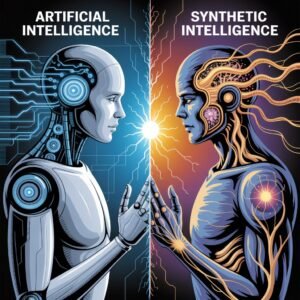
To answer that, we must revisit the distinction between Artificial Intelligence and Synthetic Intelligence.

Authorship Requires Agency
Throughout history, authorship has always been tied to four core elements:
- Intent
- Decision-making
- Context
- Responsibility
AI fulfills none of these independently.
An AI system:
- Does not start creation
- Does not choose meaning
- Does not understand impact
- Can’t be held accountable
Every AI-assisted artwork exists because a human made choices:
- What prompt to write
- What factors to set
- What outputs to refine, reject, or curate
- What meaning to assign
This makes AI a creative instrument, not a creative agent.

Why Synthetic Intelligence Changes the Ethical Landscape
If Synthetic Intelligence were to exist—truly autonomous, self-directing, and capable of forming intent—the ethics of authorship would fundamentally change.
At that point, we would be forced to ask:
- Can an intelligence be an author?
- Can it own intellectual property?
- Can it be morally or legally accountable?
- Who is responsible for harm, misuse, or infringement?
These questions are not hypothetical fear-mongering. They are ethical groundwork for a future that does not yet exist—but may someday.
Crucially:
We should not apply SI ethics to AI tools that do not have agency.
Doing so distorts the conversation and unfairly penalizes artists working with current-day technology.
The Ethical Responsibility of the Artist
In the age of AI, ethical responsibility does not disappear—it becomes clearer.
The artist remains responsible for:
- How tools are used
- What sources inform the work
- How originality is asserted
- How attribution and transparency are handled
Ethical AI art is not about avoiding tools—it’s about using them consciously.
This mirrors every technological shift in art history:
- Photography
- Digital illustration
- Sampling in music
- 3D modeling
- Generative design
The medium evolves.
The responsibility remains human.
Fear vs. Literacy
Much of the panic surrounding AI and copyright stems from technological illiteracy, not malicious intent.
When we blur the line between AI and Synthetic Intelligence, we create:
- Fear where understanding is needed
- Regulation before clarity\
- Exclusion instead of education
Artists do not lose authorship by using tools.
They lose authorship when they surrender intention.
A Call for Ethical Courage
The future of creativity does not belong to machines.
It belongs to artists who understand their tools, shape their narratives, and take responsibility for their work.
AI is not the end of authorship.
It is a test of it.
And Synthetic Intelligence—if it ever arrives—will demand not panic, but wisdom.
Until then, the artist remains sovereign.
Final Note from The Haus of Legends
At The Haus of Legends, we believe creativity is not about replacing the human spirit—but expanding it.
Technology does not diminish artistry.
Unexamined fear does.
Stay curious.
Stay ethical.
Stay legendary.
Our conversation continued